
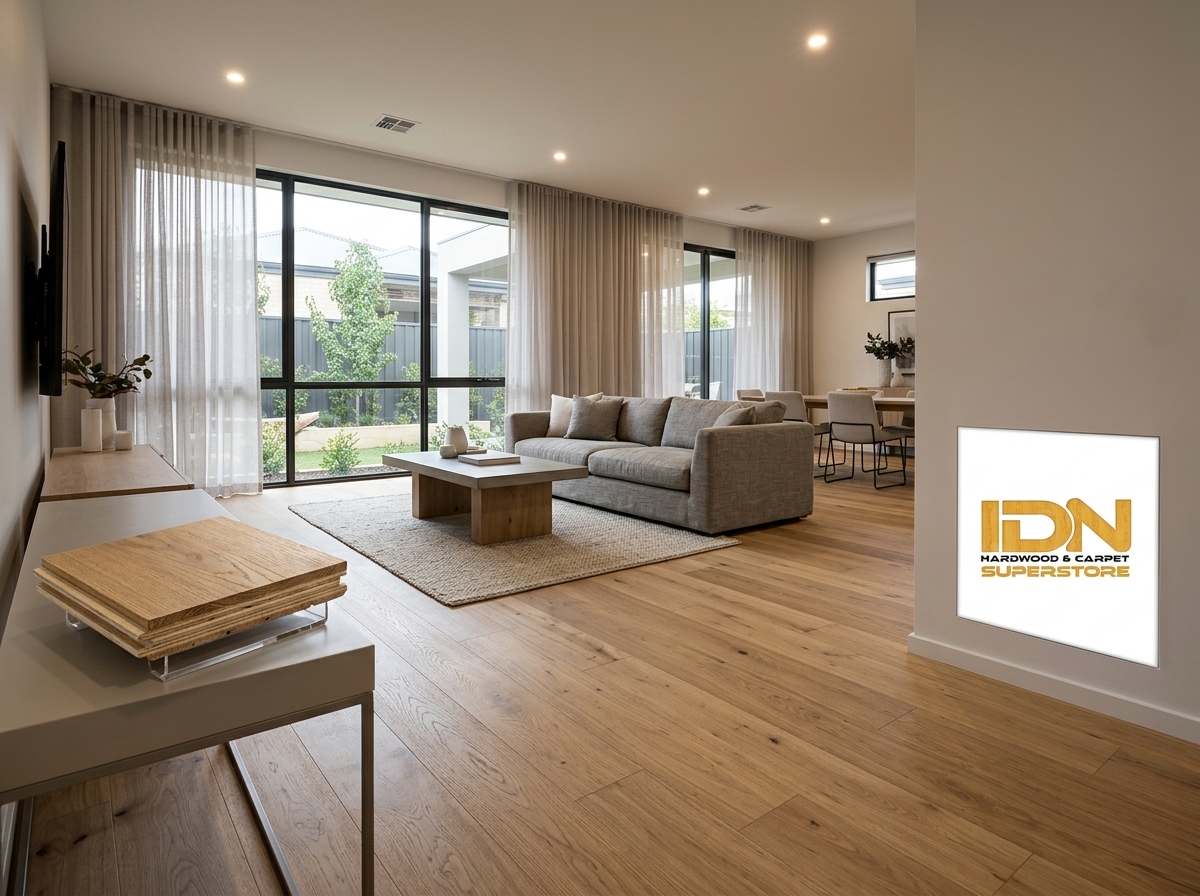
Of all the materials I talk homeowners through, an engineered hardwood floor is probably the one that gets the most misunderstood. Some people assume it’s a lesser version of solid hardwood, while others think it’s basically the same thing with a different name. Neither is quite right, and after years of installing both across Mission Hills, North Hollywood, and the rest of the San Fernando Valley, I want to clear up exactly what you’re getting when you choose engineered hardwood.
In this article: what an engineered hardwood floor actually is, seven facts that matter before you buy, and honest answers to the questions homeowners ask most.
What Is an Engineered Hardwood Floor, Exactly?
An engineered hardwood floor is built with a real hardwood veneer on top, bonded to multiple layers of plywood or high-density fiberboard underneath. That layered construction is the key difference from solid hardwood, which is a single, uniform piece of wood all the way through.
Fact #1: It’s Real Wood, Not a Wood-Look Imitation
This is the biggest misconception I run into. An engineered hardwood floor has a genuine hardwood wear layer on top — it’s not a printed image like laminate or vinyl. That means it has the same natural grain variation, texture, and character you’d expect from solid wood.
Fact #2: It Handles Humidity and Temperature Changes Better
Because of its layered, cross-grain construction, an engineered hardwood floor is generally more dimensionally stable than solid hardwood. It expands and contracts less with seasonal humidity shifts, which makes it a practical choice for homes in areas that see warm, dry stretches followed by periods of higher moisture.
Fact #3: It Can Often Go Where Solid Hardwood Can’t
Solid hardwood is typically installed above grade, meaning it’s not recommended for basements or rooms directly over concrete slabs. Engineered hardwood, thanks to its more stable core, can often be installed in these spaces when solid wood isn’t a realistic option — though we always confirm this with proper moisture testing first.
Fact #4: Not All Engineered Hardwood Is Built the Same
The thickness of the top wear layer varies significantly between products, and that thickness determines how many times, if ever, the floor can be sanded and refinished. Thicker wear layers offer more flexibility down the road, which is something we walk through during your consultation rather than leaving to guesswork.
Fact #5: Installation Methods Can Vary
Depending on the product and the subfloor, an engineered hardwood floor can be installed using nail-down, glue-down, or floating methods. Each approach has its own advantages, and the right choice depends on your subfloor type, the room, and the specific product you select.
Fact #6: It Still Requires Proper Subfloor Prep
Even though engineered hardwood is more forgiving than solid wood in some ways, it’s not a shortcut around good installation practices. Moisture testing and subfloor leveling remain essential steps — skipping them can undermine even the highest-quality engineered product.
Fact #7: It Can Last for Decades With the Right Care
With proper installation and reasonable care, an engineered hardwood floor can last for many years, and higher-quality products with thicker wear layers can even be refinished once or twice over their lifespan. According to the National Wood Flooring Association, proper acclimation and installation practices remain the most important factors in how long any hardwood product performs over time, engineered or solid.
Engineered Hardwood vs. Solid Hardwood: Which Fits Your Home?
There’s no universal answer here — it depends on your home’s specific conditions. Homes with more consistent humidity and no moisture concerns often do beautifully with solid hardwood. Homes in areas with more temperature or humidity swings, or with rooms over concrete, often benefit more from the added stability of an engineered hardwood floor. We assess this room by room, not as a blanket recommendation.
Choosing the Right Engineered Hardwood for Mission Hills and North Hollywood Homes
Homeowners throughout Mission Hills and North Hollywood often deal with a mix of older construction and newer additions, sometimes within the same house. That variation is exactly why we evaluate each room individually before recommending a specific engineered hardwood product, rather than assuming one solution fits the whole home.
Frequently Asked Questions
Is engineered hardwood cheaper than solid hardwood?
It varies by product, but engineered hardwood is often comparable in price to solid hardwood, with the value coming from added stability rather than a lower cost.
Can engineered hardwood flooring be refinished?
It depends on the thickness of the top wear layer. Some products can be refinished once or twice, while thinner wear layers may not allow for refinishing at all.
Is engineered hardwood a good choice for kitchens?
It can be, though we still recommend caution around areas with frequent standing water, similar to solid hardwood.
How do I know which engineered hardwood product is right for my home?
That’s exactly what an in-home or showroom consultation is for — we look at your subfloor, room usage, and style preferences before making a recommendation.
Explore Engineered Hardwood Options in Person
If you’re in Mission Hills, North Hollywood, or anywhere in the San Fernando Valley and want to see engineered hardwood samples up close, we’d love to help you compare your options. Request a free consultation, or visit our Canoga Park showroom on Google Maps.
READ MORE: