
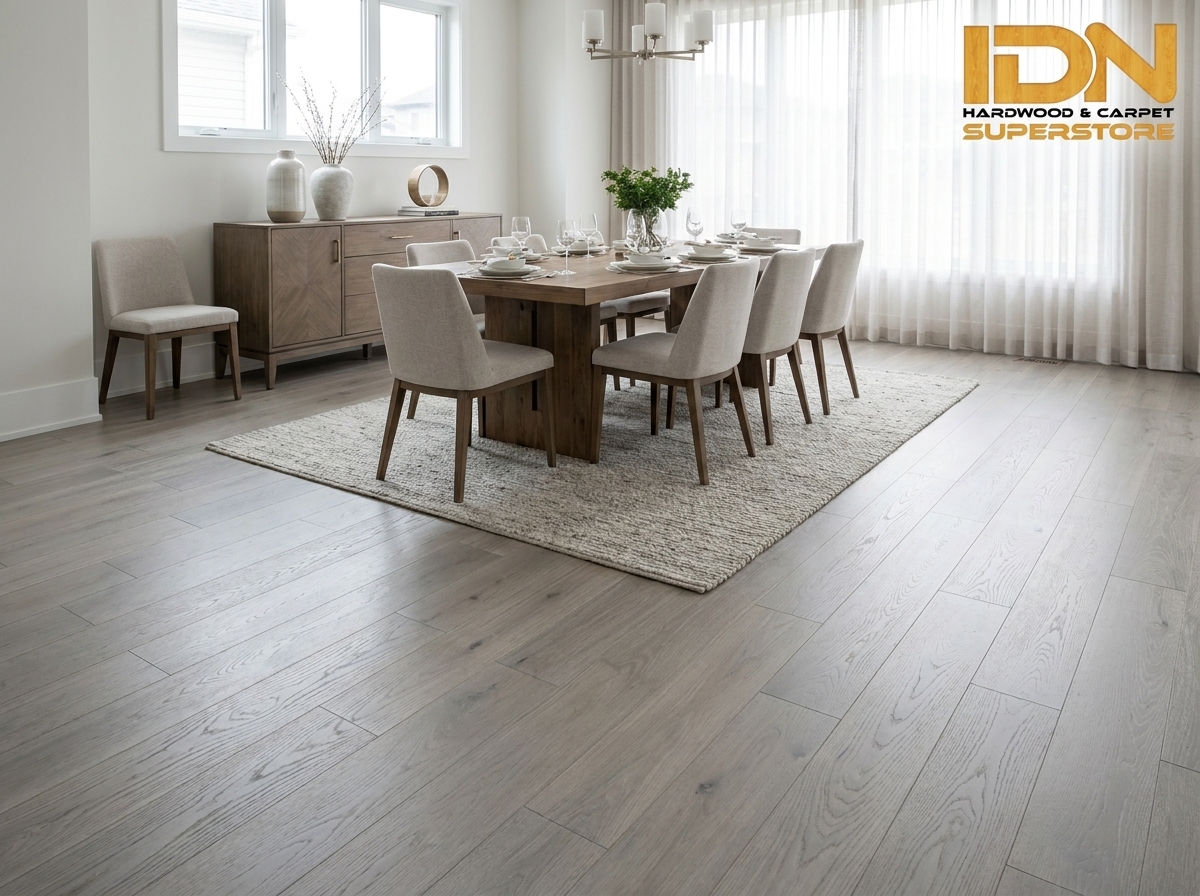
One of the biggest reasons homeowners choose engineered hardwood flooring is that it can go places solid hardwood often cannot. The most common example is a concrete slab. Many homes in Hidden Hills, Calabasas, and across Southern California have slab foundations or concrete subfloors in parts of the house, and people still want the look of real wood. It can work beautifully, but only when it is done in the right order.
In this article: why engineered wood suits concrete, why moisture testing comes first, and how the installation methods differ.
Why Engineered Wood Suits Concrete
Engineered hardwood flooring has a real wood surface bonded to a layered core. That construction makes it more dimensionally stable than solid wood, meaning it reacts less to changes in humidity. Concrete holds and releases moisture, so stability matters. Solid hardwood is generally recommended for use above grade over a wood subfloor, which is why engineered products are the usual choice for slabs.
Moisture Testing Comes First
Concrete can look dry and still release moisture. Before any wood goes down, the slab should be tested. The National Wood Flooring Association emphasizes that moisture testing and proper subfloor conditions are essential for wood flooring performance. We evaluate the slab, compare the readings to the requirements of the specific product, and discuss next steps if the numbers are too high. That might mean a moisture barrier, additional preparation, or choosing a different material.
Check the Slab’s Flatness
Wood needs a flat surface. Low spots and high spots in the concrete can cause hollow sounds, flexing, and stress on the joints. We check flatness and, where needed, level the slab before installation. Skipping this step is a common reason floors disappoint.
Three Common Installation Methods
Glue-down. The planks are bonded directly to the slab with adhesive. This gives a solid, quiet feel and is common over concrete.
Floating. The planks connect to each other and rest on an underlayment. It can be efficient, and the underlayment may include a moisture barrier.
Plywood subfloor system. A plywood layer is installed over the slab, and the wood is fastened to it. This adds height and cost but can allow other installation options.
The right method depends on the product, the slab, and your expectations. Always follow what the manufacturer allows.
What About Radiant Heat?
Some homes have radiant heating in the slab. Many engineered products are approved for use with radiant systems, but requirements vary by product, including temperature limits and installation method. Tell us up front so we can choose accordingly.
Think About Transitions and Height
Adding a floor changes the height of the surface. That affects doors, appliances, and how the new floor meets adjoining rooms. Planning for this early prevents awkward surprises, and our engineered wood flooring installation page covers what we consider.
Serving Hidden Hills, Calabasas, and the Surrounding Area
We work with homeowners in Hidden Hills and Calabasas, where larger homes often combine different foundation types in one property. See other communities we serve on our service area page.
Frequently Asked Questions
Can engineered hardwood be installed over concrete?
Yes, in many cases, following moisture testing and the manufacturer’s requirements.
Do I need a moisture barrier?
Often, depending on test results and the installation method. We recommend based on the slab and product.
Which installation method is best?
It depends on the product and conditions. We discuss the options during your consultation.
Can engineered wood work with radiant heat?
Many products are approved for it, but check the specific product’s requirements.
Start With the Slab
If you are considering wood over concrete, let’s look at the conditions first. Request a free consultation or visit our Canoga Park showroom on Google Maps.