The seven clearest signs of poorly installed vinyl plank flooring are seam gaps, peaking joints, hollow or soft spots, flooring jammed against walls, planks pinned under cabinets, heat-driven movement near sunny glass, and edges lifting at doorways. Seam gaps usually show up first. Most floating vinyl plank systems are designed to move slightly with temperature, which is why so many of these symptoms trace back to how that movement was handled in a San Fernando Valley home.
Let’s walk through each sign. For every one, you’ll see what it looks like, why it happens, and what it tells you about the installation. Some are cosmetic. Others point to a problem that tends to grow.
1. Gaps opening between planks
Visible gaps along the short or long seams are the most common sign of an installation problem. A properly locked click joint should close tight, with no line of subfloor showing through.
Gaps usually come from one of three causes. First, the locking profile was damaged during installation, often by tapping too hard without a tapping block. Then there’s an uneven subfloor, which lets one plank flex and slowly pull its joint apart. Finally, the floor may have been installed in a cold room and later shrank more than expected once conditions settled.
Think of it as a zipper. If one tooth is bent, the whole run can start to separate under foot traffic. A hairline that appears seasonally and closes again is often normal movement. A gap that keeps widening, or catches dirt and a fingernail, is not.
Widening gaps deserve a closer look.
2. Peaking or tenting where planks meet
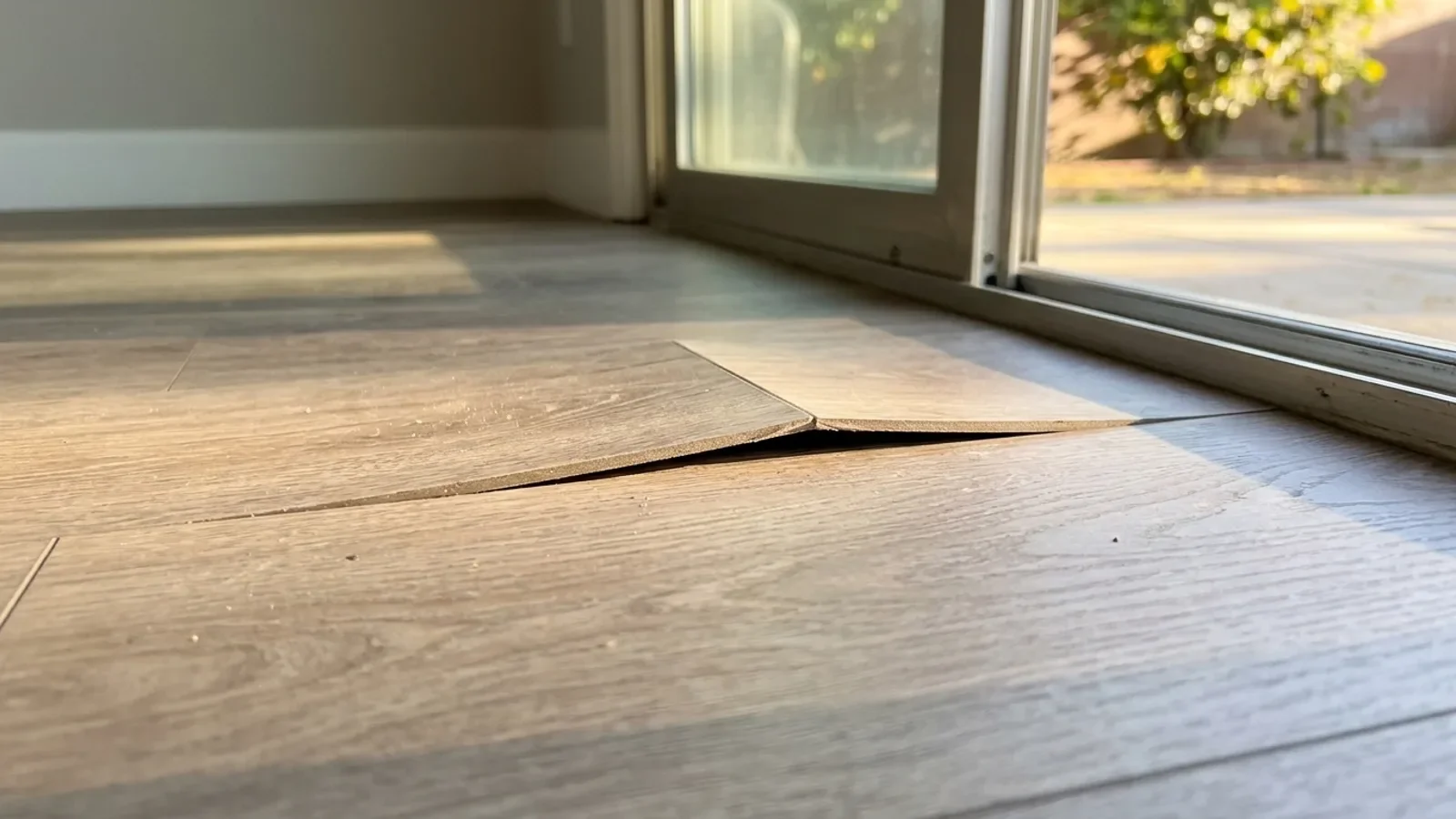
Peaking is when two planks push against each other and rise into a small ridge at the joint. You’ll often feel it before you see it, as a slight bump under a sock or a rocking feeling as you step across.
This symptom almost always means the floor has nowhere to go. A floating vinyl floor expands as it warms, and if it is boxed in at the edges or held down in the middle, the pressure releases upward at the weakest seam. This is why peaking frequently appears in the middle of a long run, far from the actual cause.
Peaking can also show up when planks were installed before they acclimated to the room. The material settles into the home’s conditions after it is already locked down, and it needs space it was never given.
The ridge is a symptom. The cause is usually elsewhere.
3. Hollow sounds, soft spots, or a bouncy feel
A hollow, drum-like sound or a spot that dips when you step on it usually means the subfloor underneath was not flat enough. Vinyl plank is thin and flexible. It follows whatever is under it, including low spots, ridges, and leftover debris.
Manufacturers publish a flatness tolerance for their products, typically expressed as a maximum dip or hump over a set distance. When a floor goes in over a subfloor that misses that tolerance, the planks bridge across the low spots. Every step then flexes the locking joints. Over time, that flexing can crack the click profile, which brings you back to sign number one.
To check, walk the room slowly in socks and listen. Tap suspicious areas lightly with a knuckle and compare the sound to a solid spot nearby.
A soft spot rarely fixes itself. If your home sits on a slab, our guide to preparing a concrete slab for vinyl plank in Canoga Park explains how flatness is measured and corrected before planks go down.
4. Flooring jammed tight against walls and trim
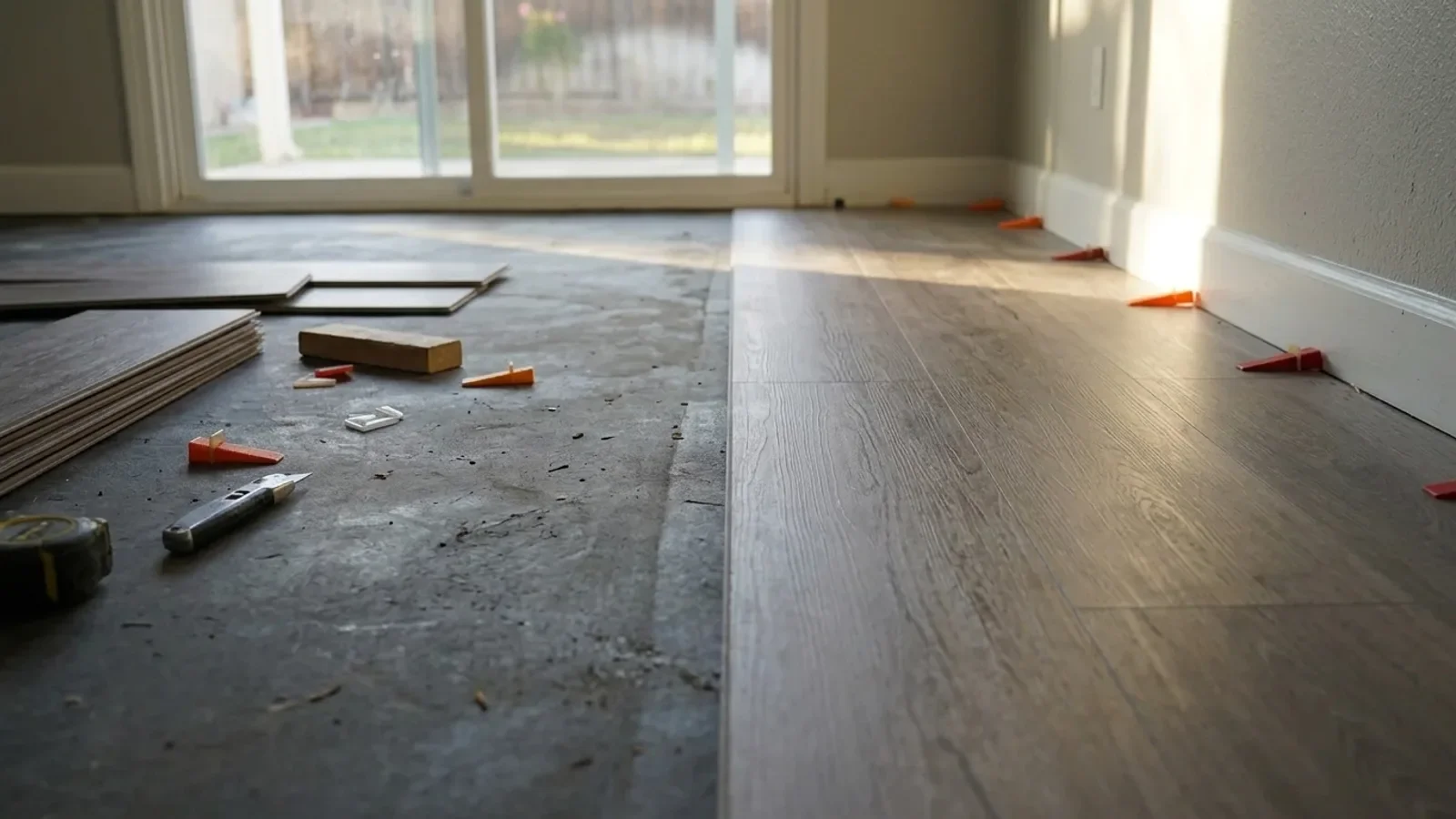
If the planks touch the wall, the door jamb, or the bottom of a fireplace hearth with no room to move, the expansion gap was skipped or filled. This is one of the easiest signs to check yourself, and one of the most consequential.
Most floating vinyl plank floors call for a small perimeter gap, hidden under baseboard or quarter round. That gap is the floor’s breathing room. Without it, normal warming has nowhere to go, and the result is the peaking described above.
Here’s how to look. Gently pull back a loose piece of quarter round in a closet, or look at a door jamb where the floor slides under the casing. You should see a slim space between the plank edge and the wall. Caulk packed into that gap, or planks wedged tight under undercut jambs, defeat its purpose.
No gap means no room to move. Many common errors start right here, and the pillar guide to avoiding vinyl flooring installation mistakes in Valley homes covers the spacing rules in more depth.
5. Kitchen islands or heavy fixtures sitting on a floating floor
A floating floor that has cabinets, an island, or a heavy built-in installed on top of it is pinned in place. That’s a problem, because the floor still wants to expand and contract around the pinned point.
Picture a sheet of material anchored in the middle. As it warms, it pushes outward from that anchor and buckles where it meets resistance. As it cools, it pulls back and can open gaps around the fixture. This is why many manufacturers ask that floating floors go around permanent cabinetry rather than under it, though instructions vary by product.
Related service: hardwood floor installation.
Signs to look for include separation along the toe kick of an island, seams opening in a line leading away from the cabinet, or peaking in a doorway between the kitchen and the next room.
Check your product’s instructions. The rules differ, and they matter.
6. Movement near sunny sliders and west-facing rooms in the Valley
In San Fernando Valley homes, the floor next to a large sliding door or a west-facing window often shows trouble first. Strong afternoon sun can heat a strip of vinyl well above the temperature of the rest of the room, and that strip expands faster than its neighbors.
The local building stock adds to this. Much of the Valley’s housing is single-story ranch construction from the postwar decades, built on concrete slabs, with wide glass openings to the backyard. Slab floors stay relatively cool while sunlit planks heat up. Summers bring long stretches of high heat, and even in late fall, dry Santa Ana conditions and warm afternoons can follow chilly nights. That daily swing makes a floor expand and contract more than it would in a milder coastal house.
Watch for seams that open in the morning and close in the afternoon, slight cupping at plank edges in the sun line, or peaking near the slider track. Some movement is expected. Repeated, visible distortion in the same sunny strip usually points to inadequate expansion space, a product not suited to direct sun, or both.
The sun line tells the story. For a deeper look at the physics, see how Valley heat affects vinyl flooring.
7. Lifting edges at doorways, transitions, and wet areas
Plank ends that lift, curl, or click when stepped on at a doorway or a transition strip usually mean the transition was installed poorly or the end joint was never properly seated. These spots take heavy traffic, so a weak joint shows up fast.
Transition strips should allow the floor to move freely beneath them. If a strip was glued or screwed down through the planks, it pins the floor in the same way a cabinet does. If the plank was cut short, the end may sit loosely in the track and lift.
Wet areas deserve special attention. Waterproof vinyl plank resists water on its surface, but the perimeter in a bathroom or laundry room still needs proper treatment, as the manufacturer specifies, around tubs, toilets, and floor penetrations. Water that sneaks down an open edge can reach the subfloor even when the planks themselves are fine.
Waterproof planks still need sealed edges. Check these areas after any spill or appliance leak.
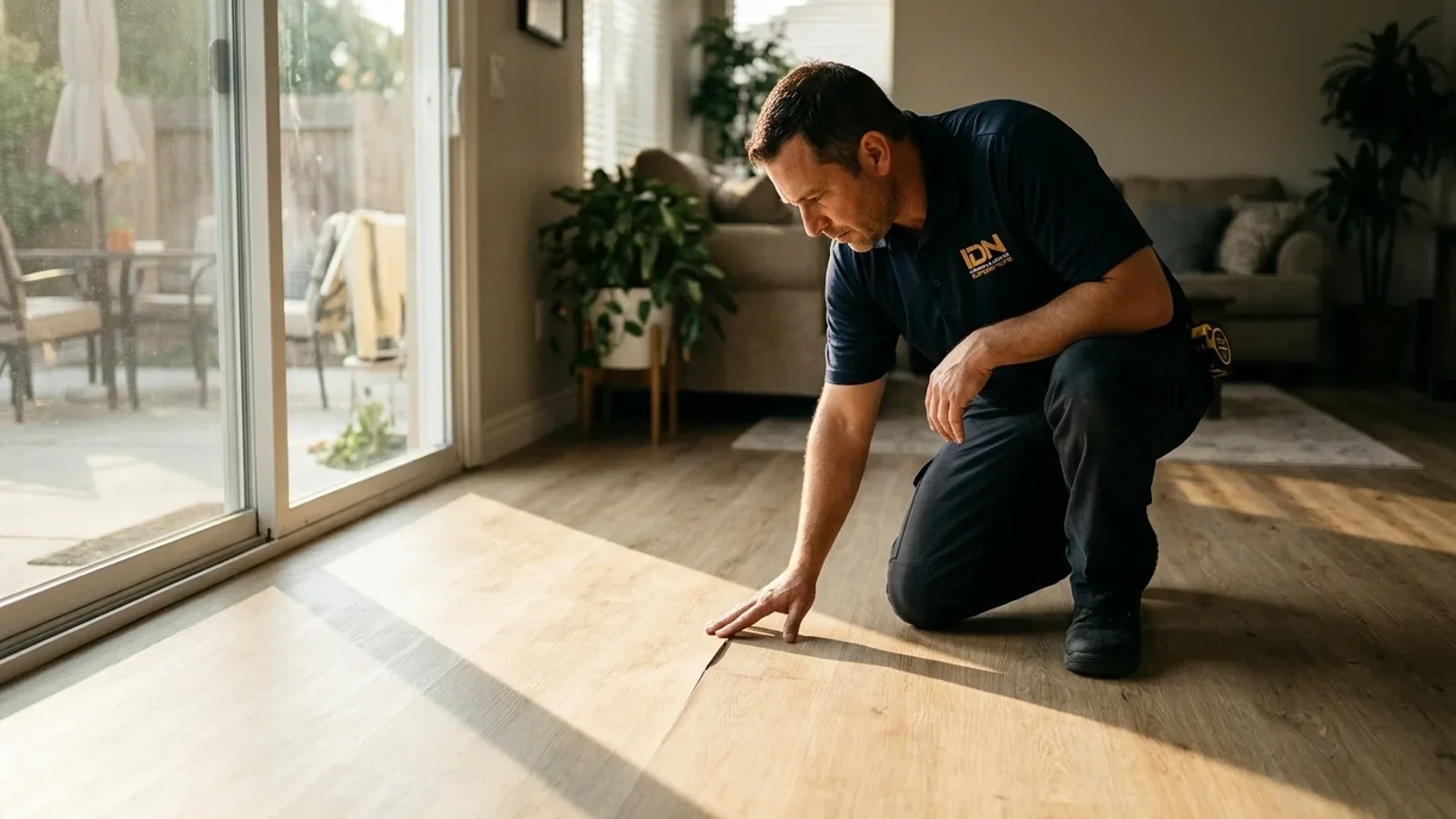
How to read these signs of poorly installed vinyl plank flooring
One sign on its own is a clue; several together usually point to a single root cause. Gaps plus soft spots point to the subfloor. Peaking plus tight walls points to missing expansion space. Seams opening around an island point to a pinned floor.
Let’s sort them into two groups. The first group is mostly cosmetic and stable, such as a single loose transition strip or one short hairline gap that never grows. The second group tends to get worse, including widening gaps, spreading peaks, and soft spots that crack locking joints over time.
Timing matters as well. Many flooring warranties exclude damage caused by improper installation, and many require that problems be reported promptly. Reading your product’s warranty terms now, and photographing what you see with a date, gives you a clear record if you need to raise a concern.
Document early. It keeps your options open.
Frequently Asked Questions
Is it normal for new vinyl plank to have small gaps?
Tiny seasonal hairlines that open and close with temperature can be normal for a floating floor. Gaps that keep widening, catch debris, or appear soon after installation usually point to a joint, subfloor, or acclimation problem worth having inspected.
Can a peaked vinyl floor go back down on its own?
Sometimes the ridge relaxes when the room cools, but it tends to return if the underlying cause remains. Lasting correction usually means restoring expansion space or freeing a pinned area, which is work for a qualified installer.
What should I do before calling about a suspected installation problem?
Take dated photos, note when the symptom appears (morning, afternoon, after a spill), and find your product’s installation and warranty documents. That record helps an installer or the manufacturer understand the cause quickly. Our guide to choosing a waterproof vinyl installer in the San Fernando Valley lists questions worth asking.
If you’re seeing any of these signs, review the installation errors that cause them, then talk with a Canoga Park flooring team about an inspection so the cause is found before it spreads.