You pull up the old carpet in the family room and there it is. Bare gray concrete, a few paint drips, maybe a hairline crack running toward the slider. That moment happens in a lot of Canoga Park living rooms, and it’s usually when the real question shows up: engineered or solid hardwood? This guide walks through engineered hardwood flooring installation across the San Fernando Valley, and when solid wood still makes sense.
We’re IDN Hardwood and Carpet Superstore, a showroom and installation team based right here in Canoga Park. We sell and install hardwood, engineered wood, laminate, vinyl and carpet. So we don’t have a reason to push one product over another. We’d rather you end up with the floor that fits your house.
The short version
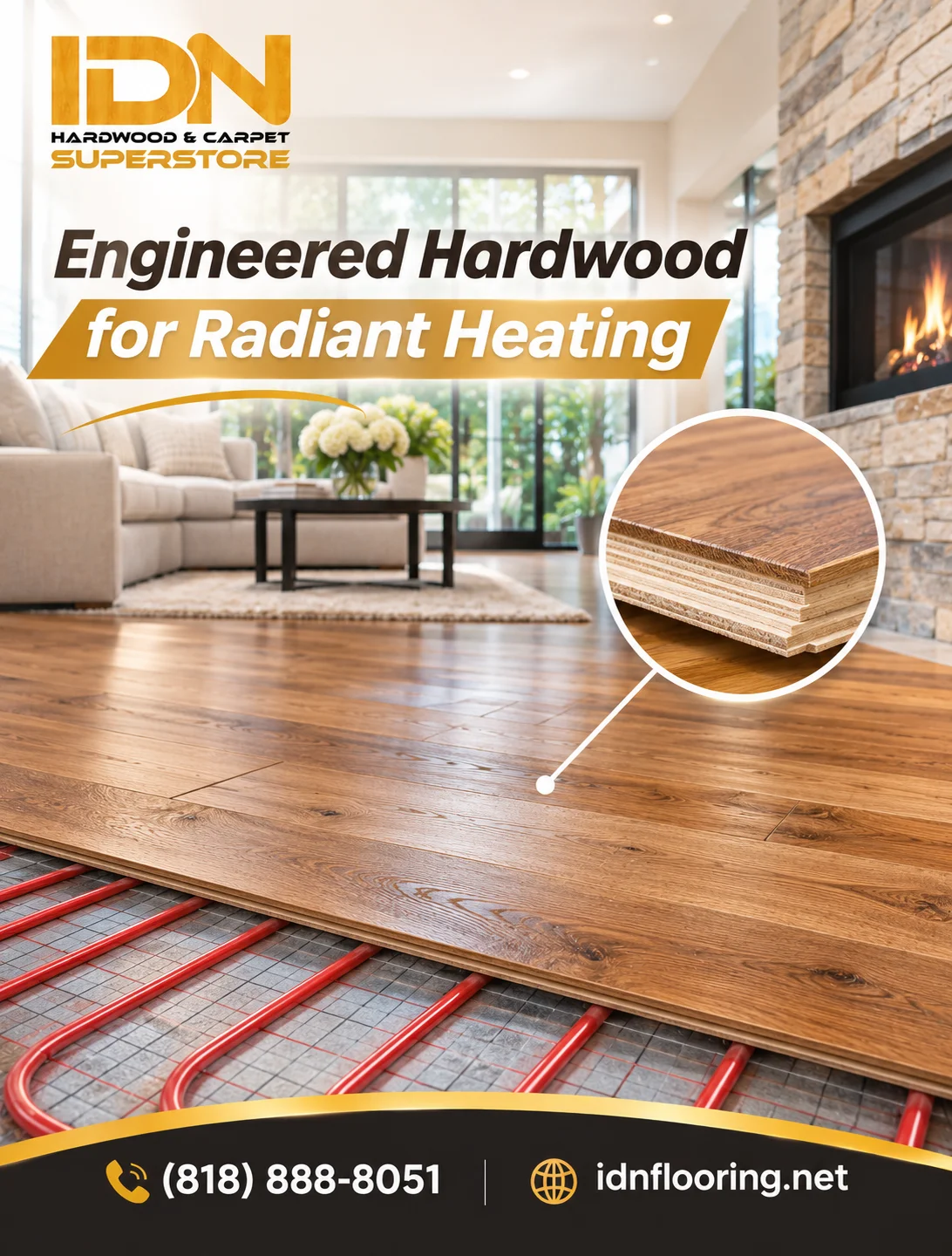
Engineered hardwood is a real wood top layer (the wear layer) bonded to a stable, cross-layered core. Solid hardwood is one piece of wood, top to bottom. Both are genuine hardwood floors. They behave differently once they’re in your home, though.
For most Valley homes built on a concrete slab, engineered is the practical choice. It can be glued directly to concrete or floated over an underlayment, and its layered core resists the shrinking and swelling that solid boards go through as seasons change. Solid hardwood typically needs a wood subfloor to nail into. That means raised-foundation homes, second stories, or a plywood system built over the slab.
Solid wins on one thing: how many times it can be sanded and refinished over its life. Engineered can usually be refinished too, but how many times depends on the thickness of its wear layer. That’s the trade.
Engineered vs solid hardwood, side by side
Here’s how the two compare on the points that actually matter for a hardwood floor installation in Los Angeles-area homes:
| Factor | Engineered hardwood | Solid hardwood |
|---|---|---|
| Construction | Real wood wear layer over a plywood or multi-layer core | One solid piece of wood throughout |
| Installs over concrete slab | Yes, glue-down or floating, with proper moisture testing and barrier | Not directly; needs a wood subfloor built over the slab |
| Installs over wood subfloor | Yes, nail, staple, glue or float | Yes, typically nailed down |
| Response to dry heat and seasonal swings | More dimensionally stable; less gapping and cupping | Moves more; gaps can open in dry months |
| Refinishing potential | Depends on wear layer thickness; thin layers allow little or none | Can be sanded and refinished many times |
| Wide planks | Well suited; wide boards stay flatter | Possible, but wide solid boards are more prone to movement |
| Floor height added | Generally thinner profiles available | Thicker boards plus subfloor can raise floor height |
| Radiant heat compatibility | Many products are rated for it (check manufacturer specs) | Generally not recommended |
Notice the pattern. Most rows come back to two things: what’s under the floor, and how dry the air gets. Both are very local questions.
Why San Fernando Valley homes push the decision toward engineered
This is the part generic flooring guides skip. The Valley isn’t coastal Los Angeles, and the floor you’d choose for a Santa Monica condo isn’t always the right call in Canoga Park.
Slab foundations are everywhere
A huge share of Canoga Park, Winnetka, West Hills and Reseda housing went up in the post-war building boom of the 1950s and 1960s. Single-story ranch homes on concrete slabs were the standard. Many of those slabs have no moisture barrier under them at all, and some have been patched, leveled or cut for plumbing over the decades. Solid hardwood can’t simply be nailed to that. Engineered planks can be glued or floated over it once the slab is tested and prepped. If you want the details on that prep, our guide to moisture barriers over Valley concrete slabs covers what testing looks like.
Heat, dry air and big swings
The west Valley runs hotter and drier than the coast. Summer afternoons regularly push well past what beach neighborhoods see, and Santa Ana wind events bring very low humidity, often in fall. Then AC runs hard all summer and heaters kick on during cool winter nights. Wood reacts to all of it.
Solid boards shrink when the air dries out, and gaps can open between planks. Engineered wood’s cross-layered core pushes back against that movement. It isn’t immune, but it’s noticeably steadier. We dig into this more in our piece on how Canoga Park’s climate affects engineered wood.
Older raised floors are a different story
Not every Valley home sits on a slab. Some older houses and many second stories have wood joists and subfloors. Some still hide original Douglas fir or oak under carpet. In those homes, solid hardwood is fully on the table, and restoring what’s already there may be worth a look before replacing anything.
When solid hardwood still makes sense
We install both, and we’d steer you to solid in a few situations:

- You have a sound wood subfloor. Raised foundations and upstairs rooms can take nail-down solid planks without extra subfloor work.
- You’re matching existing solid floors. Extending an original oak floor into a new room usually looks best with the same construction, sanded and finished together.
- You plan to stay for decades. If you want to refinish the floor several times over its life, solid gives you the most material to work with.
Outside those cases, engineered usually does the job with fewer headaches. Especially on a slab.
What our engineered hardwood flooring installation actually involves
A good wood floor installation is mostly preparation. The planks going down is the satisfying part, but it’s the last step, not the main one.
Before the first plank
We start by looking at the subfloor. On concrete, that means checking moisture and flatness, since high spots and dips telegraph through a finished floor. On wood subfloors, we check for loose areas, squeaks and soft spots. We also talk through layout: which direction the planks run, how transitions meet tile or carpet, and how doorways and stairs are handled.
The wood itself needs attention too. Flooring generally should acclimate to the home’s conditions before installation, following the manufacturer’s guidelines. Rushing that step is one of the common reasons floors gap or cup later.
Choosing the method
Engineered hardwood can go in three main ways. Glue-down bonds planks directly to the slab and gives a solid, quiet feel underfoot. Floating installs click or glue planks to each other over an underlayment, which suits some slabs and some products. Nail or staple-down is used over wood subfloors. The right method depends on the product, the subfloor and the room. We’ll explain which one we’d use and why.
Finishing details
Expansion gaps at walls, clean baseboard or quarter-round work, flush transitions and straight lines in long open runs are what separate a floor that looks right from one that just covers the room. That’s where we spend our care. If you’re ready to see how this would work in your space, take a look at our hardwood installation services in the Valley or stop by the Canoga Park showroom to see planks in person.
What shapes the cost of the project
We won’t list prices here, because every home is different and an honest quote depends on what’s actually in your house. But we can tell you what moves the number.
- Product choice: species, plank width, wear layer thickness and finish all matter.
- Subfloor condition: slab grinding, leveling, moisture mitigation or subfloor repair add work.
- Removal: tearing out old tile is far more labor than pulling carpet.
- Layout complexity: stairs, lots of doorways, angled walls and diagonal patterns take more time.
- Installation method: glue-down, floating and nail-down each involve different materials and labor.
When you’re comparing quotes, make sure each one covers the same scope, especially prep and removal. Our breakdown of what goes into an engineered hardwood quote goes line by line. And before you hire anyone, it helps to have a short list of questions to ask your flooring contractor.
Living with your new floor in the Valley
Engineered wood is easy to live with, but a few habits go a long way here. Keep indoor humidity reasonably steady, since running heat on dry winter nights can pull moisture from the wood. Felt pads under furniture help. So do doormats, because the fine dust and grit that blows around the Valley acts like sandpaper on a finish.
Skip steam mops and soaking wet cleaning. Use a cleaner made for wood floors and a barely damp mop. Our guide to caring for engineered wood in the San Fernando Valley has the full routine.
Frequently Asked Questions
Can engineered hardwood be installed directly over a concrete slab in Canoga Park?
Yes, in most cases. Engineered hardwood can be glued down or floated over a slab once it’s been tested for moisture and checked for flatness, with the right moisture protection in place.
Is engineered hardwood real wood?
Yes. The surface you walk on is a layer of genuine hardwood, bonded to a stable core underneath. It looks and feels like wood because it is wood.
Can engineered hardwood be refinished?
Often, yes. How many times depends on the thickness of the wear layer, so products with a thicker top layer give you more refinishing options over the life of the floor.
Which handles San Fernando Valley heat and dry air better?
Engineered hardwood generally holds up better to seasonal temperature and humidity swings because its layered core resists shrinking and swelling. Solid wood can still perform well with good humidity control and proper installation.
Do I need a permit for a hardwood floor installation?
Requirements vary by city and by the scope of work, especially if structural or subfloor changes are involved. Check with your local building department or ask us during your consultation.
Does IDN also install other types of flooring?
Yes. Along with solid and engineered hardwood, we sell and install laminate, vinyl and carpet, which lets us suggest different materials for different rooms when it makes sense.
Ready to compare planks in person?
Photos only tell you so much. Seeing engineered and solid boards side by side, in real light, makes the choice a lot clearer. Come by our Canoga Park showroom, bring a few photos of your rooms, and we’ll talk through your subfloor, your layout and what fits your home. When you’re ready, reach out to schedule an in-home measure.