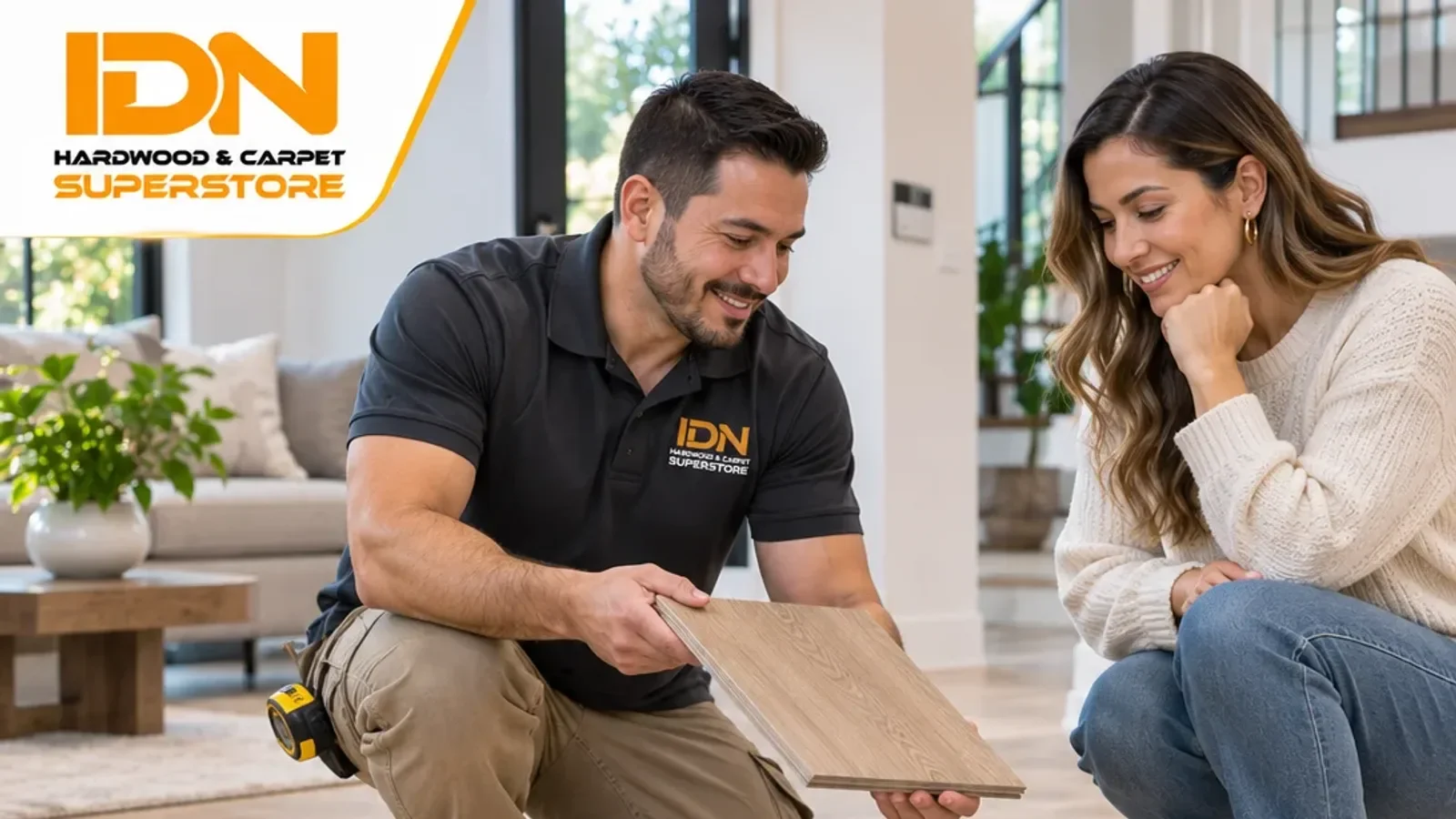
A hardwood floor that goes in wrong rarely fails on day one. It fails slowly. Seams open a little each dry Santa Ana week, a hollow spot near the slider starts to click, and a board by the kitchen cups after a wet winter. In Canoga Park and across the West Valley, most of those problems trace back to things nobody asked about before the job started. This guide walks you through the questions to ask a hardwood flooring contractor, in the order you’d actually ask them, so you can hire with confidence.
We’re IDN Hardwood and Carpet Superstore, a flooring showroom and installation team based right here in Canoga Park. We sell and install hardwood, engineered hardwood, laminate, vinyl and carpet, and we answer these same questions for homeowners every week. Use them with anyone you’re considering, including us.
Before you start
Have a few things ready before the first conversation. It makes every answer easier to judge.
- Rough room measurements for each area you want covered, plus stairs if any.
- What’s under your current floor, if you know: concrete slab, plywood, or an older plank subfloor.
- A short list of flooring types you’re leaning toward (solid hardwood, engineered hardwood, or something else).
- Photos of trouble spots: stains, soft areas, gaps along walls, uneven transitions.
- Your timeline, including any move-in date or other trades working in the house.
- A notepad or phone notes so you can compare answers side by side later.
Step 1: Confirm the license and insurance first
Ask for the contractor’s California state license number and check it yourself on the Contractors State License Board website. Look at whether the license is active and what classification it covers. Then ask who carries liability insurance and workers’ compensation for the people actually installing in your home. If the crew is subcontracted, ask whether those installers are covered too. A confident contractor hands this over without hesitation. Requirements can vary by project size and scope, so if anything is unclear, the licensing board is the place to confirm it.
Step 2: Ask who will actually install the floor
The person who quotes the job isn’t always the person on their knees nailing boards. Ask whether the installers are in-house or subcontracted, how long they’ve worked with the company, and who supervises on site. Ask who you call if something looks off mid-project. You want one clear point of contact. Short answer, clear name, that’s a good sign.
Step 3: Ask how they’ll check your subfloor
This is the question that separates a careful installer from a quick one. Ask how they’ll evaluate flatness, what tolerance they work to, and what they do when they find dips or humps. For wood subfloors, ask about squeaks, loose panels and fastener schedules. For concrete, ask how they’ll test moisture before anything goes down.
- Do they test slab moisture, and with what method?
- Will they grind high spots or use leveling compound on low ones?
- Is subfloor prep included in the quote or priced separately?
Most Valley ranch homes sit on concrete, so this matters a lot here. We’ve written a separate breakdown of moisture barriers for hardwood over Canoga Park slabs if you want the detail behind that question.
Step 4: Ask about acclimation and moisture readings
Wood moves with humidity. Ask how long the flooring will sit in your home before installation, where it will be stored, and whether the installer takes moisture readings of both the wood and the subfloor. A good answer references the manufacturer’s acclimation guidance and actual meter readings, not a fixed guess. Ask what happens if readings come back out of range. The honest answer is: they wait.
Step 5: Ask which material fits your house, and why
Solid and engineered hardwood behave differently, especially over concrete and in our swing between dry winds and cooler, damper winters. Ask the contractor to explain why they’d recommend one over the other for your rooms, not just which one they stock more of. Ask about installation method too: nail-down, glue-down or floating. Each suits different subfloors. If you want to compare the two before that conversation, our guide to engineered versus solid hardwood floor installation in Los Angeles lays out the tradeoffs room by room.

How Canoga Park homes change the conversation
Canoga Park’s housing stock gives these questions extra weight. A large share of homes here are single-story postwar ranches built on concrete slabs, with some older raised-foundation houses mixed in, often carrying original Douglas fir or oak under carpet. Slabs from that era generally weren’t poured with today’s vapor barriers in mind, so moisture testing isn’t optional busywork. The climate adds another layer. The West Valley runs hotter and drier than the coast in summer, and Santa Ana wind events in fall and winter can drop indoor humidity fast, which is exactly when poorly acclimated boards shrink and gap. Then winter rain arrives. A contractor who works the Valley regularly should bring these conditions up without being prompted. For a deeper look, see how West Valley heat and dry winds affect engineered floors.
Step 6: Get a written, line-item quote
Ask for the quote in writing with each part listed: material, underlayment or moisture barrier, subfloor prep, removal and disposal of the old floor, baseboard or quarter-round, transitions, stairs, and furniture moving. Ask what is not included. A single lump-sum number makes comparing bids nearly impossible. It also hides where costs might change. Our article on what drives an engineered hardwood quote in the Valley explains each line so you know what to look for.
- What could trigger a change order?
- How are change orders approved and documented?
- What’s the deposit and payment schedule?
Step 7: Ask about the schedule and daily routine
Ask how many days the job should take and what can push it longer. Ask what time crews arrive, how dust is controlled, and whether you can use the kitchen or bathrooms during work. If there’s sanding and finishing, ask about cure times before furniture and foot traffic. Ask how they’ll protect walls, cabinets and doorways. These details shape your week. Get them in writing.
Step 8: Ask about warranties and aftercare
There are usually two warranties: the manufacturer’s on the product and the installer’s on the workmanship. Ask how long each lasts, what they cover, and what voids them. Some manufacturer warranties depend on proper acclimation, approved cleaners or humidity ranges, so ask for those conditions in writing. Then ask what routine care the installer recommends. Our care guide for engineered wood in Valley homes covers the basics most warranties expect.
Step 9: Walk the finished floor together
Before final payment, ask for a walkthrough. Check transitions, edges along walls and cabinets, and any spot you flagged early on. Walk the floor in socks and listen for hollow sounds or clicks. Ask about leftover boards, since a spare box helps with future repairs. Note anything you want addressed, and agree on when it will be handled.
When to call a professional in Canoga Park
Asking good questions is your job. Some checks are not. If you notice any of these, have a flooring professional look before new wood goes down:
- Dark staining, a musty smell or efflorescence on a concrete slab.
- Soft or bouncy spots in a raised-foundation floor.
- Cracks in the slab wider than a hairline, or a noticeable dip across a room.
- Old floor coverings or adhesives whose makeup you don’t know, which can need careful handling during removal.
- Original hardwood under carpet you’re thinking about restoring instead of replacing.
Structural, plumbing or foundation issues belong with the right licensed trade. A flooring installer should tell you when something is outside their scope. That honesty is worth noting.
Frequently Asked Questions
How many quotes should I get for hardwood installation?
Two or three detailed, written quotes usually give you enough to compare. Focus on what each one includes, especially subfloor prep and moisture work, rather than just the total.
Should the contractor test my concrete slab for moisture?
For any wood floor over concrete, moisture testing is a sensible step and many manufacturers expect it. Ask what method they use and what they’ll do if results are high.
How long should hardwood acclimate in a Canoga Park home?
It depends on the product and on readings taken in your home. Follow the manufacturer’s guidance and your installer’s moisture measurements instead of a fixed number of days.
Is engineered hardwood a better choice over a slab?
Engineered hardwood is often a practical fit over concrete because of its layered, more dimensionally stable construction. Your subfloor condition and how the room is used should guide the final call.
Can old hardwood under my carpet be saved?
Often, yes. Original Douglas fir and oak floors in older Valley homes can frequently be repaired, sanded and refinished, depending on how much wear layer remains.
The short version
Check the license. Find out who installs. Ask hard questions about subfloors, moisture and acclimation, then get everything in writing. Those few conversations do more for the life of your floor than almost any product choice.
If you’d like to ask us these questions in person, stop by our Canoga Park showroom or reach out to talk through your rooms. We’re glad to walk you through samples, explain our process and help you plan a hardwood installation that suits your home. Bring your measurements and your list.