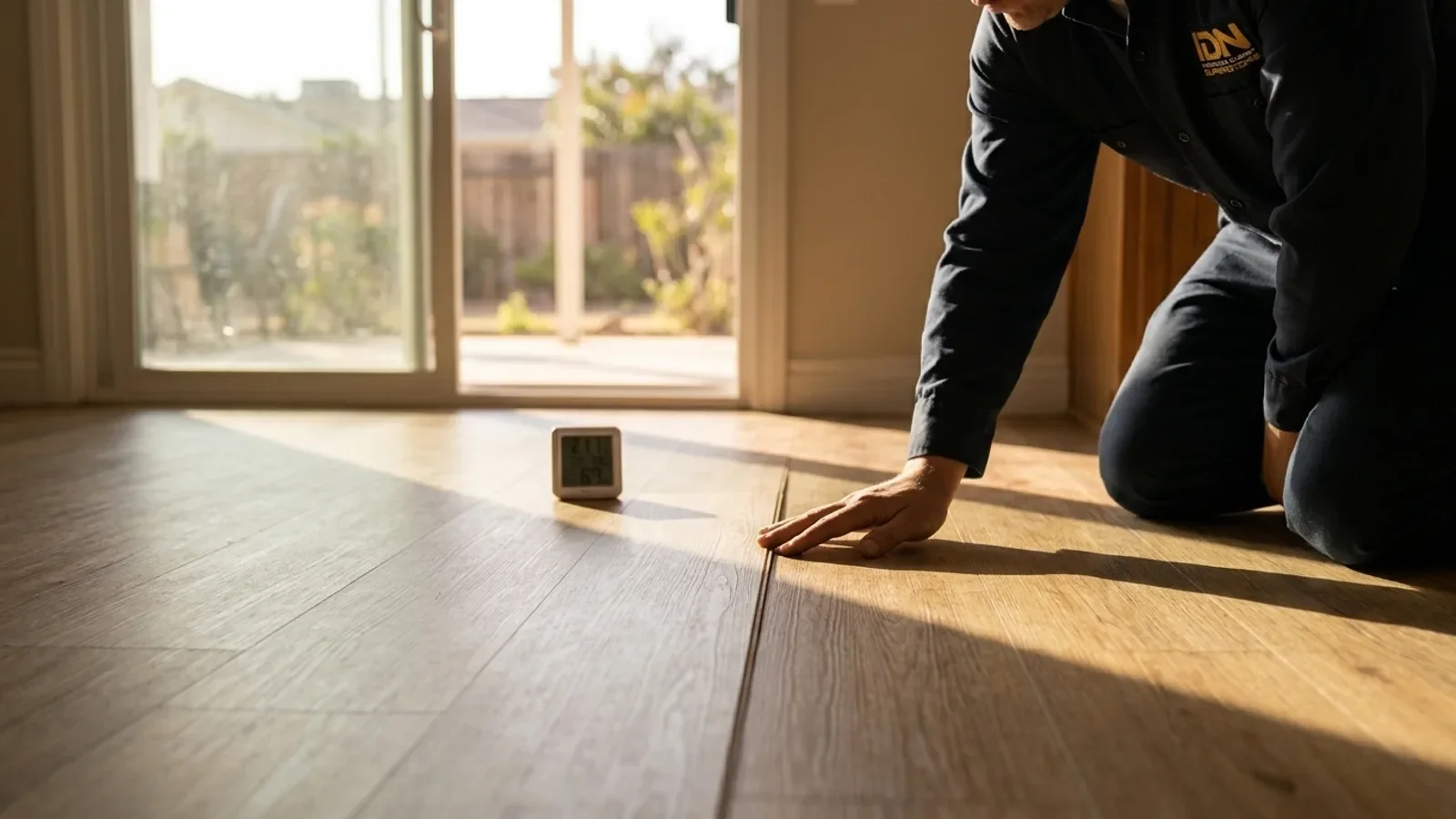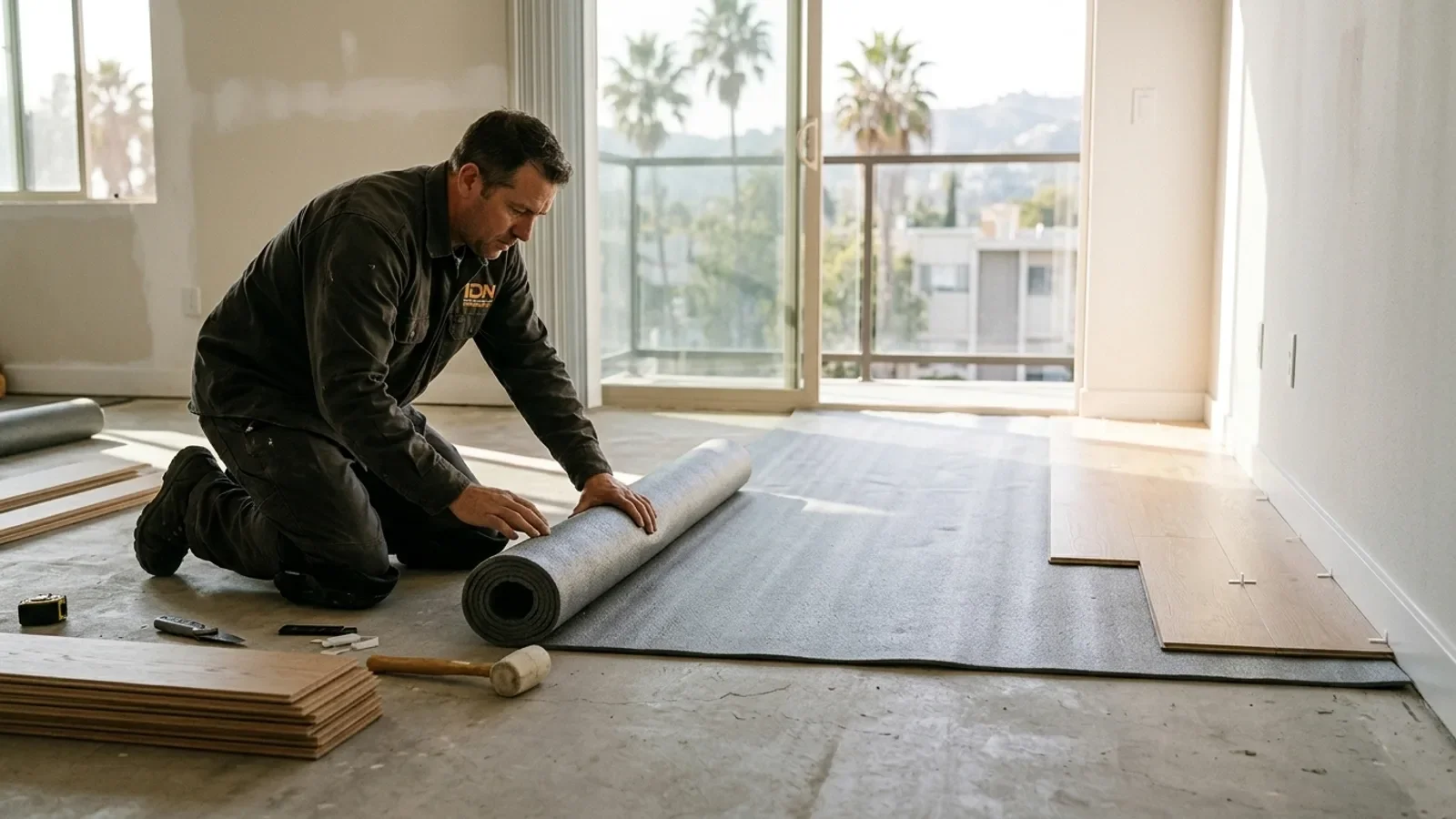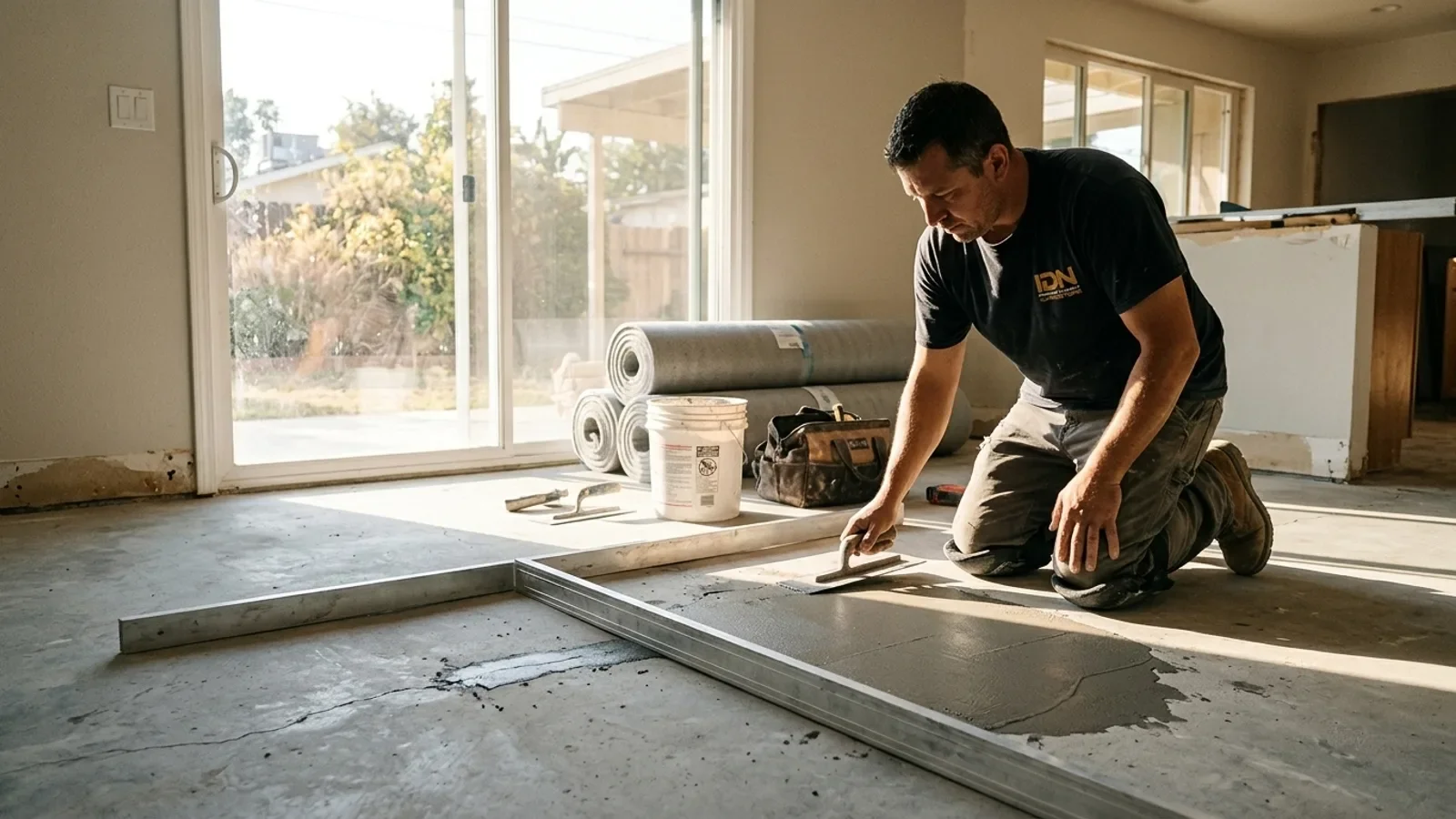
Yes, a Canoga Park slab needs a concrete moisture test before laminate flooring goes down, even if it looks bone dry. Concrete keeps moving vapor up from the ground for its entire life. Testing measures that vapor, and the result tells your installer which moisture barrier and underlayment the floor actually needs.
The short version
- A dry-looking slab can still release enough moisture vapor to damage laminate planks over time.
- Laminate has a wood-fiber core, so vapor from below can cause swelling, cupping and peaking at the seams.
- Many San Fernando Valley homes sit on slab foundations, which puts the floor in direct contact with ground moisture.
- The right moisture test and barrier depend on the slab, so check the plank manufacturer’s installation instructions before choosing a barrier.
- A vapor barrier is cheap insurance next to the cost of replacing swollen planks.
Concrete is porous. Even a slab poured decades ago never fully stops breathing moisture up from the soil beneath it. That matters in Canoga Park because so much of the West Valley’s housing was built on slab-on-grade foundations, from mid-century tract homes to newer townhomes and condos. When homeowners hear “dry climate,” they assume the concrete under their carpet is dry too. That assumption is where most of the myths below start, and it’s why we see so much confusion about whether testing is worth doing.
Myth: The Valley is a desert, so slabs here don’t have moisture problems
Reality: Dry air above the slab says nothing about the soil below it. The moisture that ruins laminate comes from the ground, not the weather.
Canoga Park summers are hot and dry, sure. But the soil under a foundation holds moisture much longer than the air does, and concrete pulls that moisture upward by capillary action. Irrigation is a big factor here. Lawns, planters and drip lines running against the foundation all keep the soil around the slab damper than you’d guess. Winter rain adds to it. In late fall and winter, when storms finally arrive, ground moisture around older foundations can climb noticeably. So the slab you’re looking at on a dry afternoon isn’t telling the whole story.
Older homes add another wrinkle. Many slabs from the postwar building boom were poured without a vapor retarder underneath, or with one that has since degraded. Without that layer, nothing slows the vapor between dirt and floor.
Myth: If the old carpet came up dry, the slab is fine
Reality: Carpet and pad breathe, so moisture escapes through them without leaving much evidence. Laminate traps it.
This one catches people constantly. Carpet lets vapor pass straight through into the room, so the slab rarely shows a wet spot. Once you lay down a tighter floor, that vapor has fewer places to go. It collects under the planks, and the fiberboard core absorbs it slowly.
The damage doesn’t show up on day one. It shows up weeks or months later as edges that lift, seams that peak, or a faint musty smell. By then the planks are usually done. A dry carpet removal is a nice sign. It isn’t a test.
Myth: A quick plastic sheet test tells you everything
Reality: Taping plastic to the floor can flag an obvious problem, but it can’t measure how much moisture is coming through.
The taped-plastic method (often linked to the ASTM D4263 standard) is a simple visual check. Tape a square of plastic down, wait, and look for condensation or darkened concrete underneath. It’s useful as a first look. It’s also very sensitive to room temperature and humidity, and a “pass” doesn’t confirm the slab is within a manufacturer’s limits.
Quantitative methods give actual numbers. The two most common in the flooring industry are calcium chloride testing, which measures the moisture vapor emission rate from the surface, and in-situ relative humidity probes placed inside drilled holes in the slab. Each follows its own procedure and acclimation time. Which one fits your job depends on the slab and on what the laminate manufacturer asks for. Their warranty language is the rulebook.
Myth: Underlayment and a moisture barrier are the same thing
Reality: Some underlayments include a vapor barrier and some don’t. Plain foam over concrete gives you cushion, not protection.
Underlayment does several jobs. It softens footfall, reduces sound, and bridges tiny surface imperfections. A vapor barrier has one job: slowing moisture moving up from the slab. Some products combine both, often a foam or felt with a film attached. Others are cushion only, meant for wood subfloors upstairs.
On concrete, most laminate manufacturers call for a polyethylene film or an underlayment with an integrated barrier, with seams overlapped and taped. Getting this wrong is one of the most common reasons floating floors fail on slabs. It’s also why our guide to laminate flooring installation in Los Angeles spends so much time on what sits under the planks, not just the planks themselves. If you live in a condo, sound ratings enter the picture too, and our piece on HOA sound requirements for underlayment explains how those rules interact with barrier choices.
Myth: Waterproof laminate doesn’t care about slab moisture
Reality: “Water-resistant” or “waterproof” ratings usually describe spills on the surface, not vapor rising from below for years.
Newer laminates handle topical water much better than older ones. Sealed edges and tighter locking systems buy you time to wipe up a spilled glass or a pet accident. That’s real progress.
Constant vapor pressure from underneath is a different stress. It acts on the back of the plank around the clock, and most manufacturers still require a vapor barrier on concrete regardless of the surface rating. Read the installation sheet, not the marketing on the box. They don’t always say the same thing.
Myth: Moisture testing is only for brand-new concrete
Reality: New slabs need curing time, but old slabs can be just as risky, sometimes more.
Fresh concrete is full of mix water and needs to dry before any floor goes on. Everyone knows that. What surprises people is that a slab from decades ago can still read high. Missing vapor retarders, poor drainage, changed landscaping, a new sprinkler zone, or a downspout dumping water beside the foundation can all raise moisture in an old slab.
Remodels in Canoga Park often reveal exactly this. The house is old, the carpet came up clean, and the readings still say “slow down.” Better to learn that before the planks go in.
Myth: Leveling and moisture are separate problems
Reality: They overlap. Dips hold moisture, and some patching and leveling compounds have their own moisture limits.
Low spots in a slab can collect condensation under a barrier. Cracks can wick moisture. And the cementitious products used to flatten a floor need the slab to be within certain conditions to bond and cure properly. That’s why moisture readings and flatness checks belong in the same prep visit.
If you’ve noticed soft spots, hollow sounds or visible dips, our breakdown of the warning signs of an uneven subfloor walks through what to look for before installation day.
Myth: Testing just adds cost without changing anything
Reality: Test results directly decide the barrier, the prep and sometimes the product, which is exactly what protects your budget.
Skipping testing doesn’t remove the moisture. It just hides the decision. A reading that comes back within limits lets you proceed with a standard barrier and confidence. A high reading points toward a heavier barrier, extra drying time, fixing drainage first, or choosing a different floor type for that room.
Those choices affect the overall scope, which is why prep belongs on any quote you compare. Our article on what shapes a laminate quote in the Valley covers how subfloor work shows up in an estimate. Replacing a failed floor means paying for materials and labor twice. Testing first is the cheaper path.
Frequently Asked Questions
Do I need a concrete moisture test before installing laminate in Canoga Park?
It’s strongly recommended for any slab, because ground moisture under Valley foundations isn’t visible from the surface. Most laminate manufacturers also set moisture limits and barrier requirements for concrete, so testing helps you follow the installation instructions.
What does too much slab moisture do to laminate?
The fiberboard core can absorb vapor and swell, which shows up as cupping, peaked seams, lifting edges or a musty smell. These problems usually appear weeks or months after installation, not right away.
Is a 6-mil plastic sheet enough of a moisture barrier?
Polyethylene film is a common barrier for laminate over concrete, but the exact requirement depends on the manufacturer and the test results. Always check the product’s installation guide before buying underlayment.
Can I install laminate on an old slab that has never been tested?
You can, but you’d be guessing about the moisture level. Older slabs may lack a vapor retarder underneath, so testing before installation is the safer route.
Does the season matter for moisture testing?
Readings can shift with rain, irrigation and indoor conditions, so testing should follow the method’s acclimation rules. Wet winter months in the Valley are a good time to see how a slab really behaves.
Before your planks go down
Moisture testing isn’t glamorous. It’s a few readings and a decision. But on Canoga Park slabs, that decision is often the difference between a floor that stays flat and one that lifts at the seams. Once your new floor is in, our tips on caring for floating laminate help it stay that way.
At IDN Hardwood and Carpet Superstore, we talk through subfloor conditions as part of choosing and installing laminate, so the barrier and underlayment match your slab. If you’re planning a project, stop by our Canoga Park showroom or reach out to plan a laminate install that starts with the slab. We’ll walk through the prep with you.