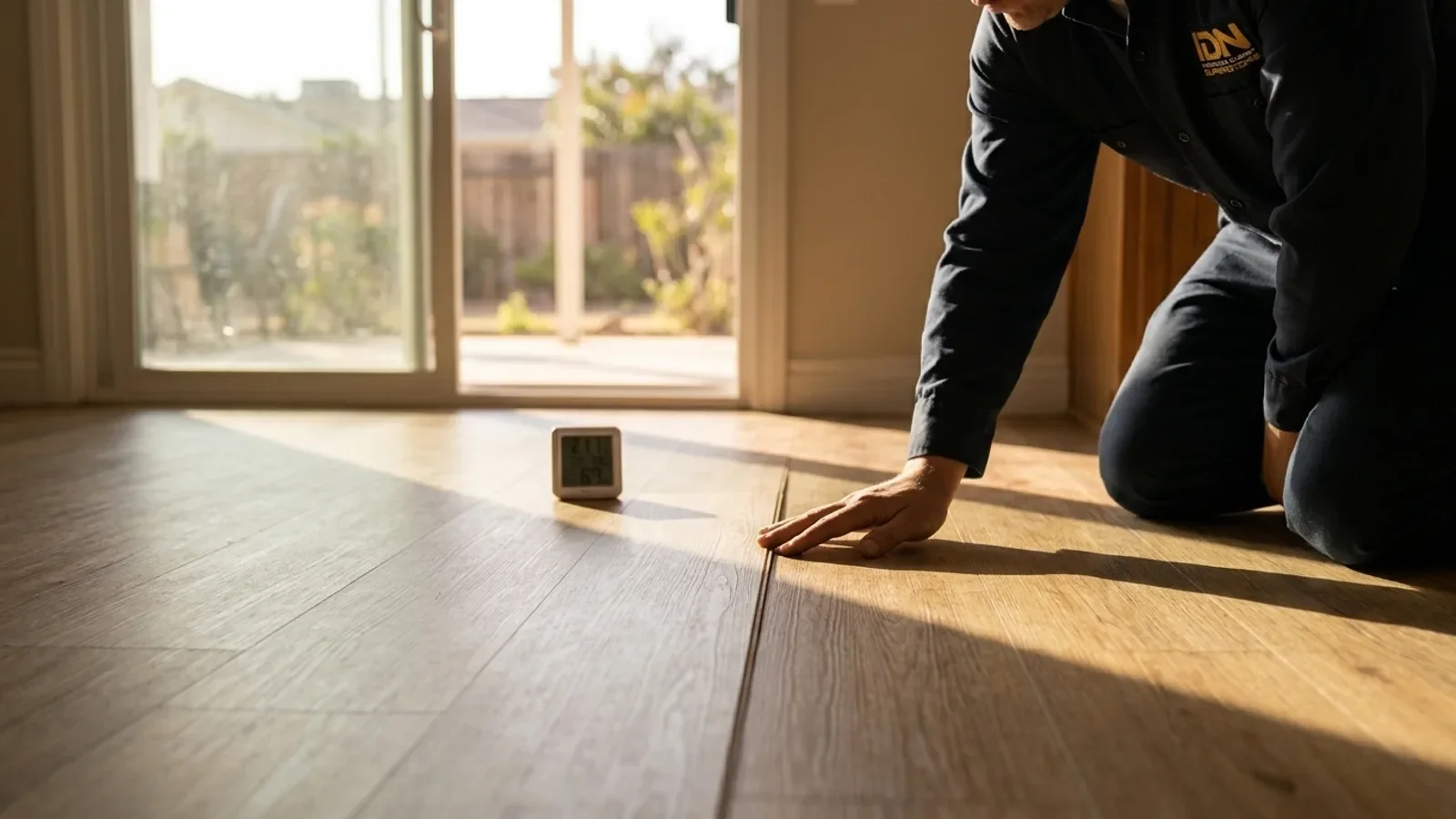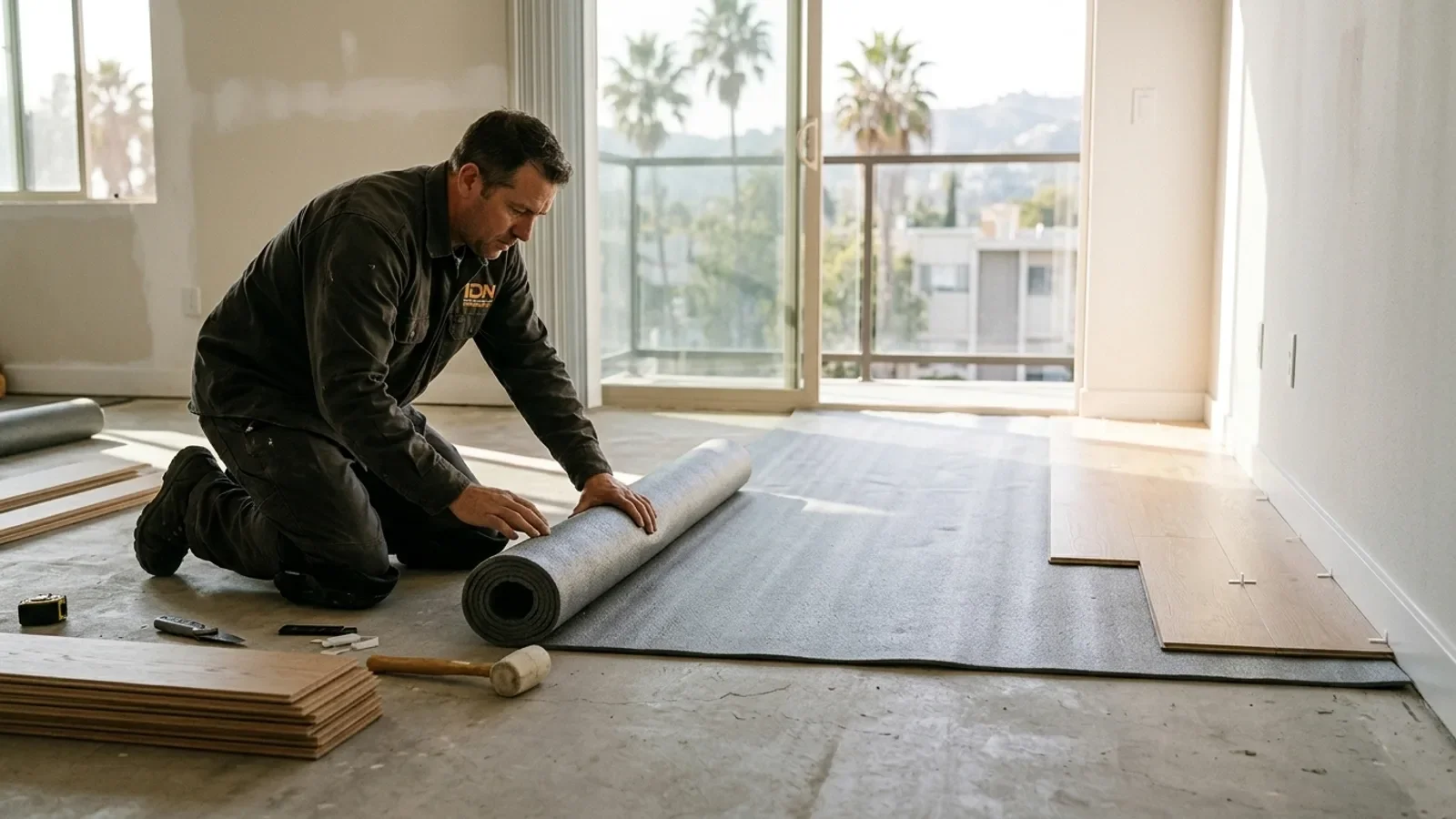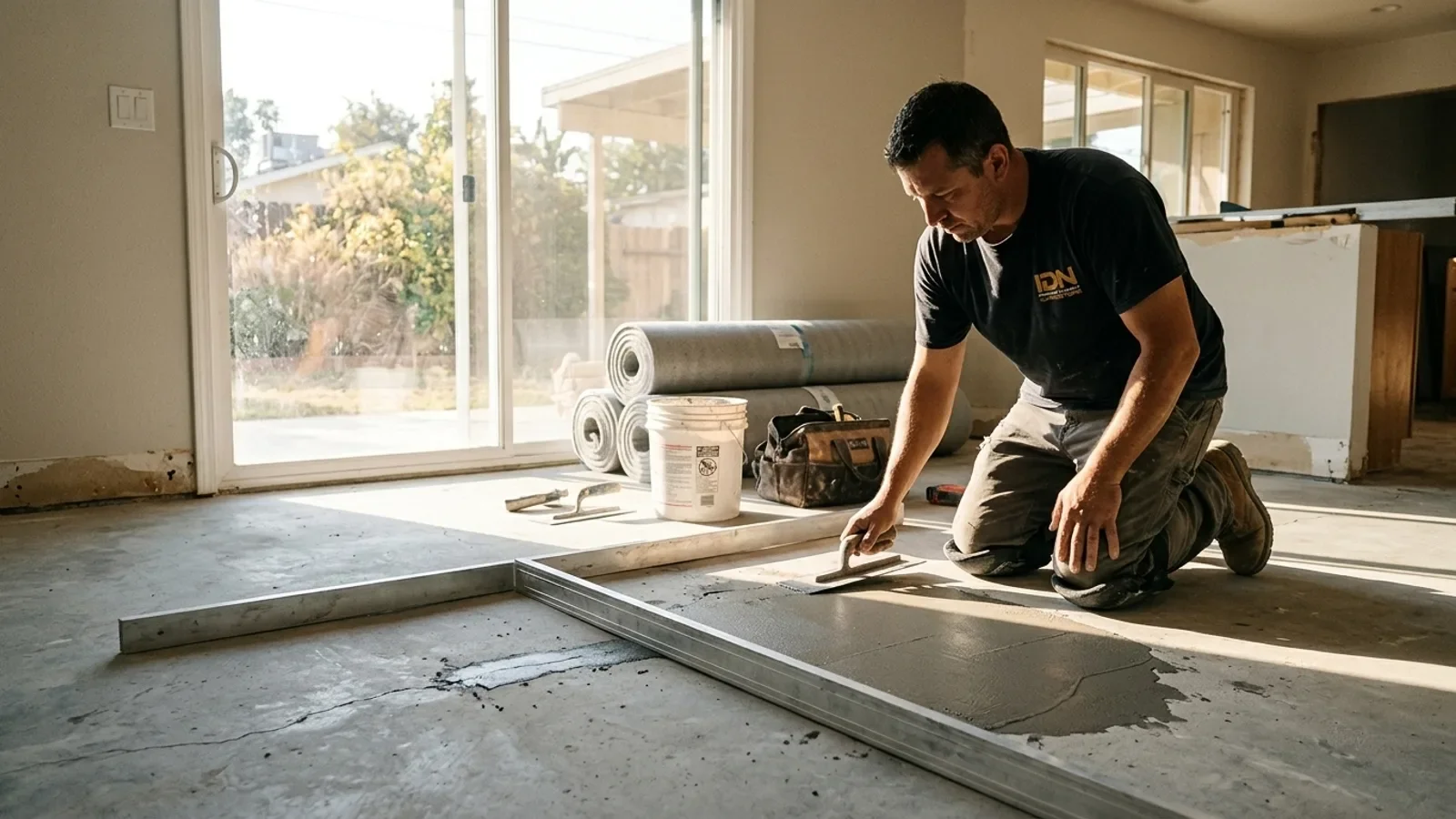
To care for floating laminate in Valley heat, keep indoor humidity steady, protect the expansion gap at every wall, block hot afternoon sun, and wipe spills dry instead of mopping wet. In Canoga Park and across the San Fernando Valley, most seam buckling traces back to big humidity swings, a pinched perimeter or moisture rising from the slab.
The short version
- Floating laminate expands and contracts as indoor humidity changes, so steady humidity matters more than any single temperature.
- The expansion gap around the room’s edges has to stay open; heavy furniture, tight trim or caulk can pinch it and push seams upward.
- Many Valley homes sit on concrete slabs, and moisture moving up through a slab without a proper barrier can lift seams from below.
- Damp mopping, standing water and steam cleaners are the fastest way to swell laminate edges.
- Seams that peak and stay peaked usually need a professional look at the gap, the underlayment or the slab, not just a heavier rug.
It usually starts with a sound. You walk across the living room on a warm afternoon and hear a soft click underfoot, then notice a faint ridge where two planks meet near the sliding door. By evening, with the AC running, it seems to settle. The next hot day it’s back, a little taller. If you live in Canoga Park, Winnetka or West Hills, this scene is familiar. The floor looked perfect when it went in. Now one seam catches your sock, and you’re wondering if something went wrong.
What that raised seam is actually telling you
A peaked or cupped seam in floating laminate means the planks are pushing against each other with nowhere to go. The floor is reacting to moisture or pressure, and the seam is the weakest point, so that’s where it shows.
Floating laminate isn’t glued or nailed down. It clicks together into one large sheet that rests on underlayment and moves as a unit. That’s by design. The core is a high-density fiberboard, which takes on a little moisture when the air is humid and gives it back when the air dries out. Each plank only moves a tiny amount. Across a whole room, though, those tiny amounts add up.
When the floor has room to grow, you never notice. When it doesn’t, the pressure has to go somewhere. It goes up.
You’ll typically see one of three things. Peaking is when two plank edges rise into a tent shape. Cupping is when the edges of each plank sit higher than the middle, often a sign of moisture coming from below. Gapping is the reverse, small openings between planks during very dry stretches. A floor can show all three over a single year in the Valley.
Why Valley homes put laminate under extra stress
San Fernando Valley homes ask more of floating laminate than many coastal homes do, because of hot inland summers, dry wind events and the slab foundations under so much of the local housing stock.
Start with the heat. Canoga Park sits deep in the west Valley, away from the marine layer that keeps the coast mild. Summer afternoons run hot, and air conditioners cycle hard. AC pulls moisture out of the air as it cools, then shuts off, and humidity drifts back up. That daily swing nudges the floor back and forth again and again.
Then there’s the dry season. In fall and winter, Santa Ana winds can push humidity down fast, sometimes for days at a time. Laminate that took on moisture over a sticky stretch can shrink quickly, and seams may open slightly. When normal conditions return, the floor swells again.
The building stock adds its own twist. A large share of Valley homes are post-war ranch houses and later tract homes built on concrete slabs. Concrete holds moisture and releases it slowly, especially older slabs that went in without a vapor retarder underneath. Sliding glass doors facing south or west are common in these floor plans too, and the planks right inside them can get noticeably warmer than the rest of the room.
Put those together and you get a floor that’s always negotiating. Heat from the windows on top, moisture from the slab below, and humidity that rarely holds still. Laminate handles this well when it’s installed with all three in mind.
How to care for floating laminate in Valley heat, day to day
Daily care comes down to keeping moisture steady, keeping the perimeter free and keeping water off the surface. None of it is complicated.
Watch your humidity, not just the thermostat. An inexpensive hygrometer tells you more about your floor than the AC display does. Many laminate manufacturers publish a recommended indoor humidity range in their warranty documents, so check yours. If readings swing widely between afternoon and night, try longer, gentler AC cycles instead of blasting the system and shutting it off. During long dry spells, a room humidifier may help keep the air from dropping too far.
Shade the hot spots. Blinds, shades or UV-filtering window film near south and west glass reduce surface heat and help limit fading. Close them during peak afternoon sun if the room sits empty.
Leave the edges alone. The expansion gap hides under your baseboard or quarter-round. Don’t caulk the trim down to the floor. Don’t let heavy pieces like pianos, built-in looking bookcases or kitchen islands pin the floor in place. If something heavy has to sit on laminate, ask about it before it goes in.
Clean dry, then barely damp. Sweep or use a soft vacuum head. When you need more, use a well-wrung microfiber pad and a cleaner the manufacturer approves. Skip steam mops and wet mopping. Water that sits on a seam can wick into the core, and swollen edges rarely shrink back to flat.
Handle the entries. Mats at exterior doors catch grit and water from sprinklers and pool decks. Check under the mats now and then, since rubber backings can trap moisture.
Use felt pads. Chair glides and furniture pads keep the wear layer looking good. They don’t affect buckling, but they do help the floor age well.
When care isn’t enough: fixing the real cause
If a seam stays raised through cooler, calmer weather, the cause is almost always below the surface or at the edges, and it needs to be corrected rather than covered up.
The first place we look is the perimeter. Trim nailed into the floor, door casings cut too tight, or a transition strip clamped down hard can all stop the floor from moving. Freeing those points sometimes lets the floor relax on its own over a few days.
Next comes the slab. If planks are cupping across a room, or the underlayment feels damp when a plank is lifted near a wall, moisture from the concrete is a strong suspect. That’s why testing before installation matters so much on Valley slabs. Our guide to testing concrete moisture in Canoga Park homes explains what those tests measure and why readings can vary room to room. On a slab, the fix generally involves lifting the affected area and making sure there’s a proper vapor barrier beneath the underlayment. You can read more about how we install a laminate moisture barrier over a concrete slab and why it’s one of the most important steps on Valley floors.
Flatness is the third piece. A floating floor bridging a dip or a hump flexes every time you step on it, and that movement wears on the locking joints. Over months, a joint that keeps flexing can loosen and start to lift. If you’re noticing soft spots or bounce along with the seam, it’s worth reading about the signs of an uneven subfloor in Valley homes.
What we don’t recommend is forcing a raised seam back down with weight or glue. It might look flat for a week. The pressure is still there, though, and it usually shows up again nearby. Gas lines, electrical outlets in the floor and anything structural are also jobs for a licensed professional, never something to work around with a pry bar.
Done properly, the repair is usually less dramatic than homeowners expect. Because floating planks click apart, an installer can often lift a section from the nearest wall, address the barrier or the gap, and click the same planks back in. Badly swollen planks get swapped for spares from the original batch, which is one good reason to keep a box after installation.
What to expect after the fix
After the cause is corrected, the floor should settle within a few days and then behave predictably through the seasons. Small, temporary changes are normal; a recurring peak is not.
Give the floor time to acclimate. Planks that were lifted and reset, or new planks brought in, need to adjust to your home’s air before they find their resting size. Keep your AC and humidity habits consistent during that stretch.
Through the year, you may still see hairline gaps on the driest Santa Ana days and a slightly snugger feel on humid ones. That’s the floor doing its job. What you shouldn’t see is a seam that keeps climbing or edges that stay cupped.
Many homeowners tell us the biggest change is how the floor sounds. A floor that was clicking or crackling underfoot tends to go quiet once it can move freely and rests on the right underlayment. If you live in a condo or townhome, sound matters to your neighbors too, and our notes on HOA acoustic underlayment rules around Los Angeles cover what associations commonly ask for.
And if you’re planning a new floor rather than rescuing an old one, start with prep. Most of the problems in this article are prevented by careful slab testing, leveling and barrier work before the first plank clicks in. That’s the heart of our laminate flooring installation work in Los Angeles, and it’s where we spend most of our time on every job.
Frequently Asked Questions
Why does my laminate floor buckle in the summer?
Summer buckling usually happens because the floor has absorbed moisture and expanded but has no room to move at the walls. A pinched expansion gap, heavy furniture or moisture from a concrete slab are the most common causes in Valley homes.
Will a raised laminate seam go back down by itself?
Sometimes it does, if the cause was a short humid spell and the perimeter is free. If the seam stays raised through cooler, drier weather, have the gap, underlayment and slab checked.
Can I use a steam mop on floating laminate?
Most laminate manufacturers advise against steam mops because heat and moisture can push into the seams and swell the core. A dry sweep followed by a well-wrung microfiber pad is the safer routine.
Does running the AC all day help or hurt laminate?
Steady cooling generally helps, because it keeps humidity more consistent. The bigger issue is large swings, so longer, gentler cycles tend to be easier on the floor than hard on-off blasts.
Keeping your floor calm through every Valley season
Floating laminate is a smart fit for Canoga Park homes. It’s tough, good-looking and forgiving of busy households. It just needs room to breathe, steady air and a dry foundation. Keep the edges free, keep water off the seams and keep an eye on humidity when the heat or the Santa Anas roll in.
If a seam has started to rise and won’t settle, come talk with us. Visit our Canoga Park showroom or reach out to schedule a visit, and we’ll help you figure out whether it’s a simple adjustment or a sign the floor needs a careful reset by our laminate installers. We’d rather catch it early.