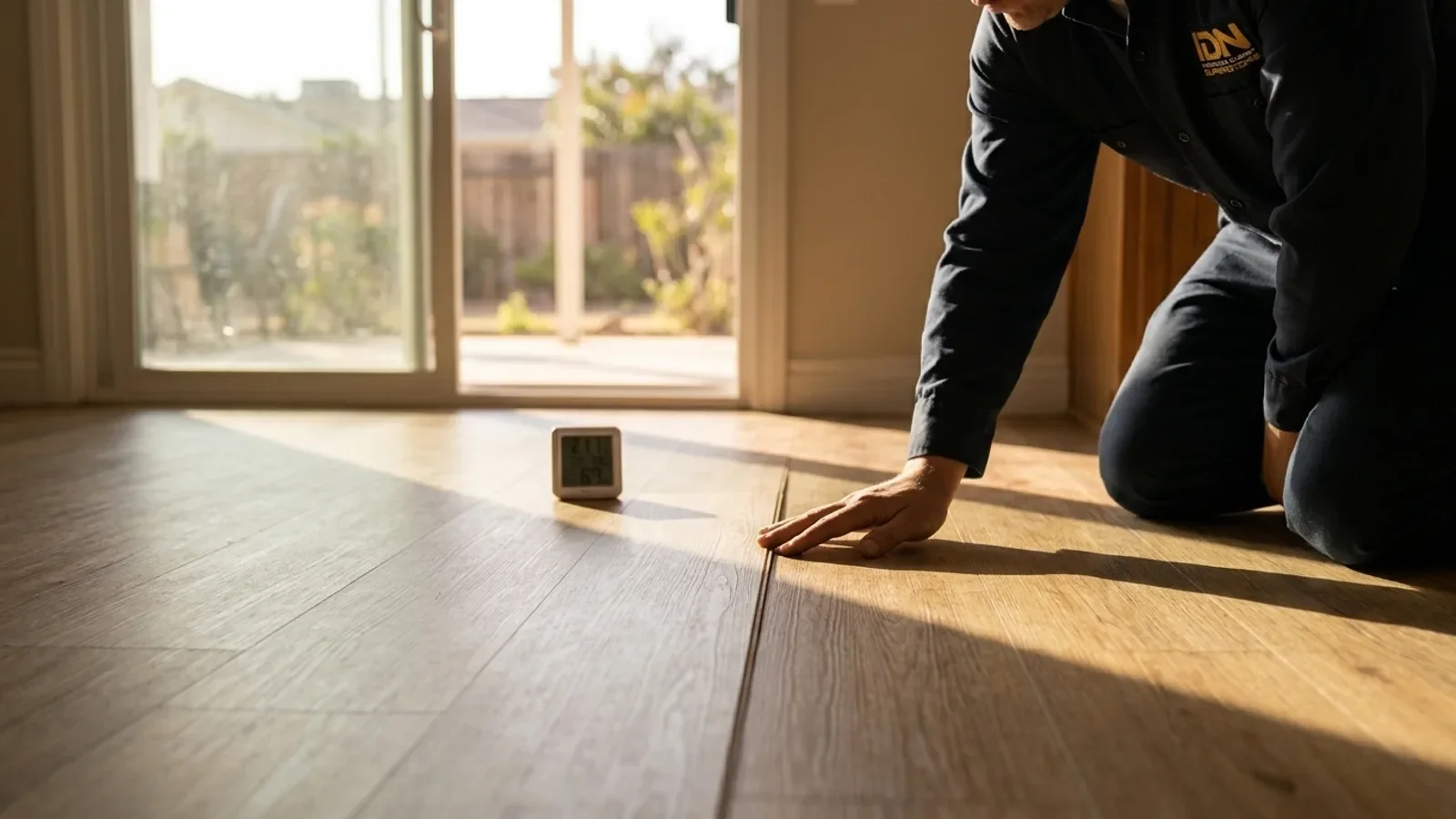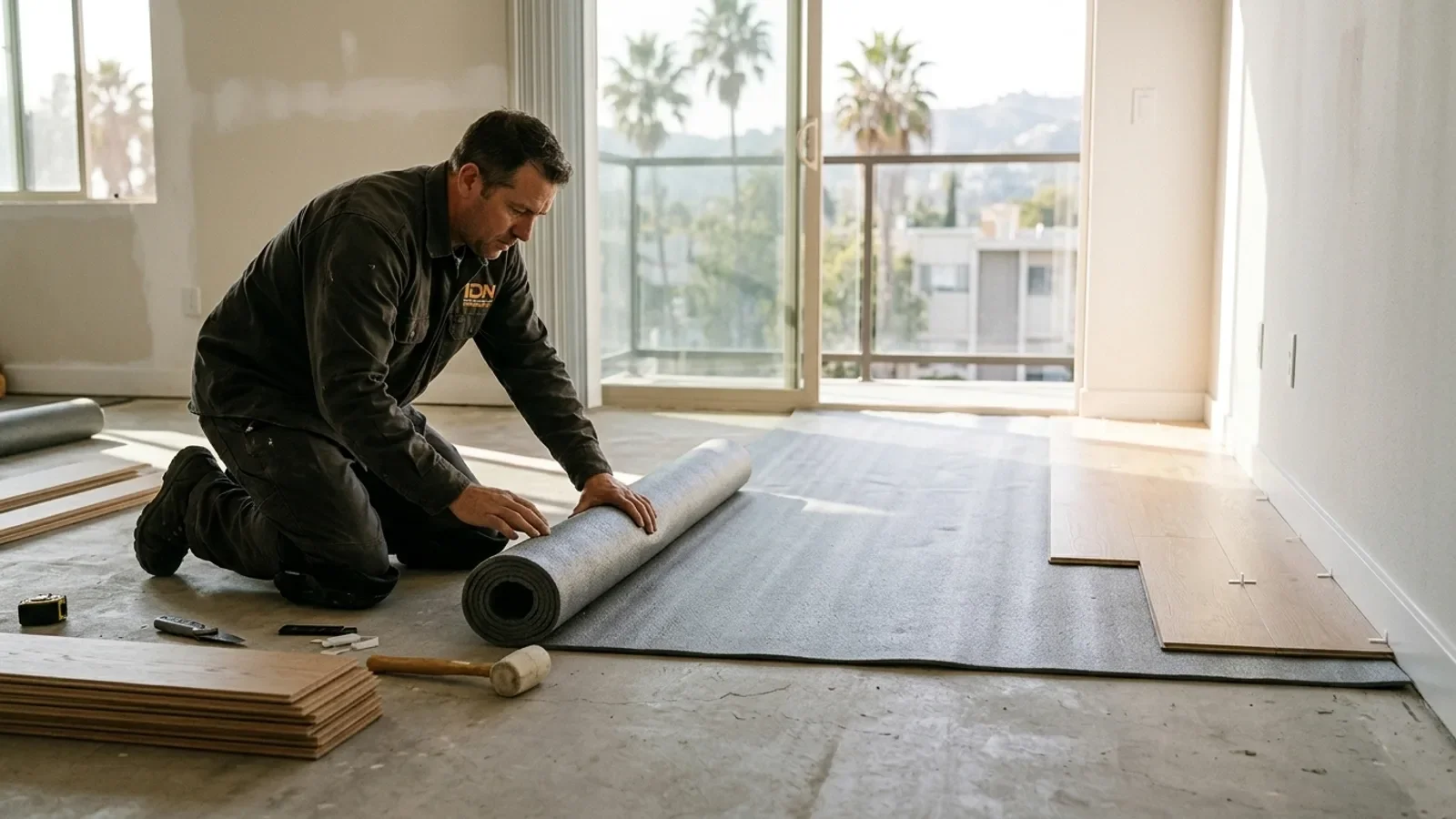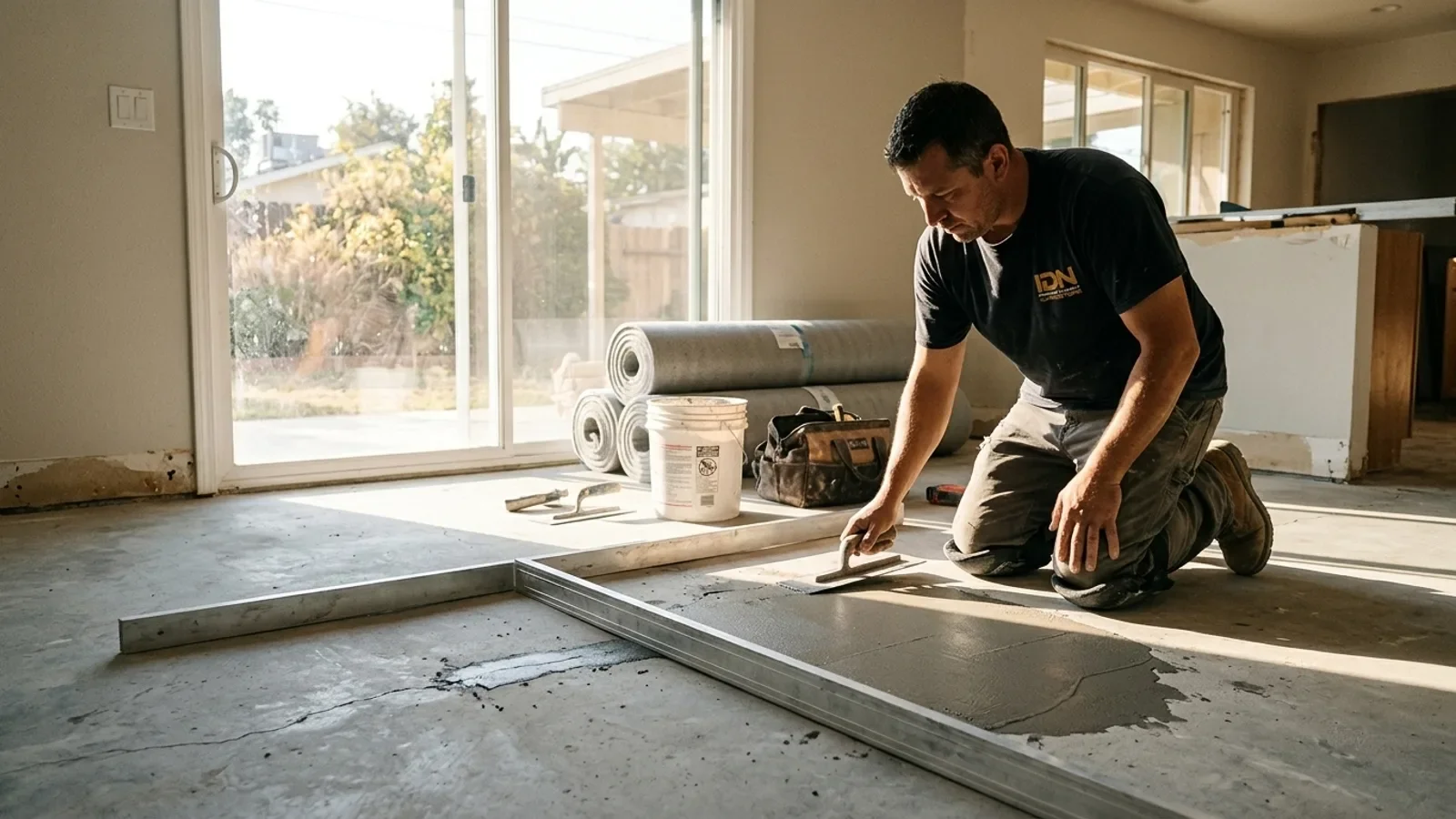
The main uneven subfloor symptoms under laminate in San Fernando Valley homes are bounce or flex underfoot, hollow or clicking sounds, and joints that open or peak. This checklist helps you spot them in Canoga Park and nearby Valley neighborhoods. The most important item is bounce in one spot. That usually means a dip in the slab below.
So how do you know if the problem is the floor or what’s under it? Usually it’s what’s under it. Laminate is a floating floor. It locks together at the edges and rests on underlayment, so it follows the shape of whatever sits beneath. When the slab or wood subfloor has low spots or humps, the planks bridge over them. The locking joints take the strain. That strain shows up as the signs below. Walk the room in socks, slowly, and use this list as you go.
What you’ll feel underfoot
- Walk the room slowly in socks and note any spot that sinks slightly, then springs back.
- Mark soft spots with painter’s tape so you can see whether they form a line or a cluster.
- Check doorways and hallway transitions, where planks often pass over a change in height.
- Stand on one foot near each suspect spot and feel for rocking, not just give.
- Compare the middle of the room with the edges, since slab dips often sit away from the walls.
- Notice whether furniture wobbles in one area of the floor but sits flat elsewhere.
- Feel for a ridge or hump that you can sense through thin-soled shoes.
Bounce in one spot is the classic sign. The plank is spanning a low area and flexing every time you step on it. Over time that flex can work the locking joints loose.
What you’ll hear when you walk
- Listen for a hollow, drum-like sound in a specific area rather than across the whole room.
- Tap suspect spots lightly with a knuckle and compare the sound with a solid-feeling area nearby.
- Note any clicking or snapping at seams, which often means joints are moving against each other.
- Listen for a crackle or crunch that may point to debris left under the underlayment.
- Record whether noises get louder over weeks, which suggests the joints are wearing.
- Check whether sounds change with the season, as some movement tracks temperature and humidity shifts.
A hollow sound alone isn’t always a problem. Some underlayments sound a bit different from area to area. A hollow spot that also bounces is a different story. That combination points to a gap between the floor and the subfloor.
What you’ll see at the seams and edges
- Look for gaps opening at short ends or long edges of planks, especially in a line.
- Check for peaking, where two plank edges lift into a small tent shape.
- Inspect for chipped or crushed edges at joints, which can come from repeated flexing.
- Look along baseboards for floor edges that sit higher in some spots than others.
- Scan for cupping or edge swelling, which can mean moisture rather than flatness is the issue.
- Lay a long straightedge across the floor and watch for daylight underneath it.
- Photograph problem seams and date the photos so you can track any change.
Separating joints are where an uneven subfloor tends to show itself first. They also overlap with moisture and expansion problems. So the next step is ruling things out. Don’t guess.
Ruling out other causes before you blame the slab
- Check that a gap is left around the room’s perimeter so the floor can expand, and that trim isn’t pinning it.
- Look for heavy cabinets, islands or built-ins sitting on top of the floating floor.
- Inspect transitions and thresholds for moldings screwed through the laminate.
- Note any recent leak, spill or plumbing work near the problem area.
- Confirm whether the room gets strong afternoon sun, which can drive heat swelling in nearby planks.
- Ask whether a moisture barrier was used over concrete during the original install.
Pinned edges and moisture can mimic an uneven floor. A floor that can’t float will buckle or gap. Flatness won’t save it. If moisture is a question, our guide to testing concrete slabs for moisture in Canoga Park explains what that check involves.
Canoga Park and San Fernando Valley considerations
- Expect concrete slab-on-grade foundations in many Valley tract homes, and check for dips near old repairs or patched cracks.
- Look for slab cracks or height changes left behind after older carpet, tile or tack strip was pulled up.
- Check for leftover thinset, mastic or tile ridges, which commonly sit under replaced flooring in older Valley homes.
- Inspect areas near former plumbing work, since slab leak repairs often leave patched sections at a different height.
- Watch for movement in rooms facing the hot, dry afternoon sun common in the west Valley.
- Note that fall and winter evenings here are cooler, so seasonal gapping may look different than in summer.
- Check raised-foundation homes for soft spots near bathrooms and laundry rooms over the crawlspace.
- Ask your HOA about underlayment rules if you live in a condo or townhome before replacing anything.
Valley slabs see real temperature swings between summer heat and cool nights. Many homes here have also been through more than one flooring change. Each change can leave patches, adhesive and small height differences behind. Condo owners should also read up on acoustic underlayment rules for Los Angeles HOAs. A fix can involve the underlayment too.
What to do once you’ve spotted the signs
- List each symptom by room, with tape marks and dated photos to back it up.
- Avoid shimming, prying or lifting planks yourself, which can damage locking joints.
- Ask a flooring professional to check flatness with a long straightedge across the whole area.
- Request an explanation of whether the fix is local leveling, full leveling or replacing damaged planks.
- Ask how moisture will be checked before any new underlayment goes down over concrete.
- Keep spare planks from the original install if you have them, as they can help with repairs.
The real fix happens before planks go down. Proper prep means grinding high spots and filling low ones. Then the surface is confirmed flat to the flooring maker’s tolerance. Our guide on subfloor leveling and prep before laminate goes down in Canoga Park walks through that process. When you’re ready to price the work, see what shapes a laminate quote in the Valley.
Frequently Asked Questions
Can I lay laminate on an uneven floor?
Not without prep. Laminate needs a flat subfloor within the manufacturer’s tolerance. High spots are ground down and low spots are filled before planks go in. Skipping that step is a common reason for bounce, noise and joint failure.
What are the most regretted flooring choices?
Regret usually comes from a mismatch between the floor and the room. Think of a floor that can’t handle moisture in a wet area, or one installed over a poorly prepped subfloor. Choosing a product suited to how the room is used, and prepping properly, avoids most of it.
What is the average lifespan of laminate flooring?
Lifespan depends on the wear layer, the traffic and how well the subfloor was prepped. A well-installed laminate floor over a flat, dry subfloor can last many years. One flexing over dips tends to wear out at the joints sooner. Good care helps too, and our tips on caring for a floating laminate floor cover the basics.
Why is my laminate flooring separating at the seams?
Seams usually separate because the floor is flexing over an uneven subfloor, moving with temperature and humidity, or pinned so it can’t float. Moisture coming up through a slab without a proper barrier can also cause it. A professional check can tell which cause applies.
The takeaway: bounce, hollow sounds and opening seams usually point to the subfloor, not the planks. If you’re seeing them in your Valley home, bring your notes and photos to IDN Hardwood and Carpet Superstore in Canoga Park and we’ll talk through getting your laminate floor installed over a properly prepped subfloor.