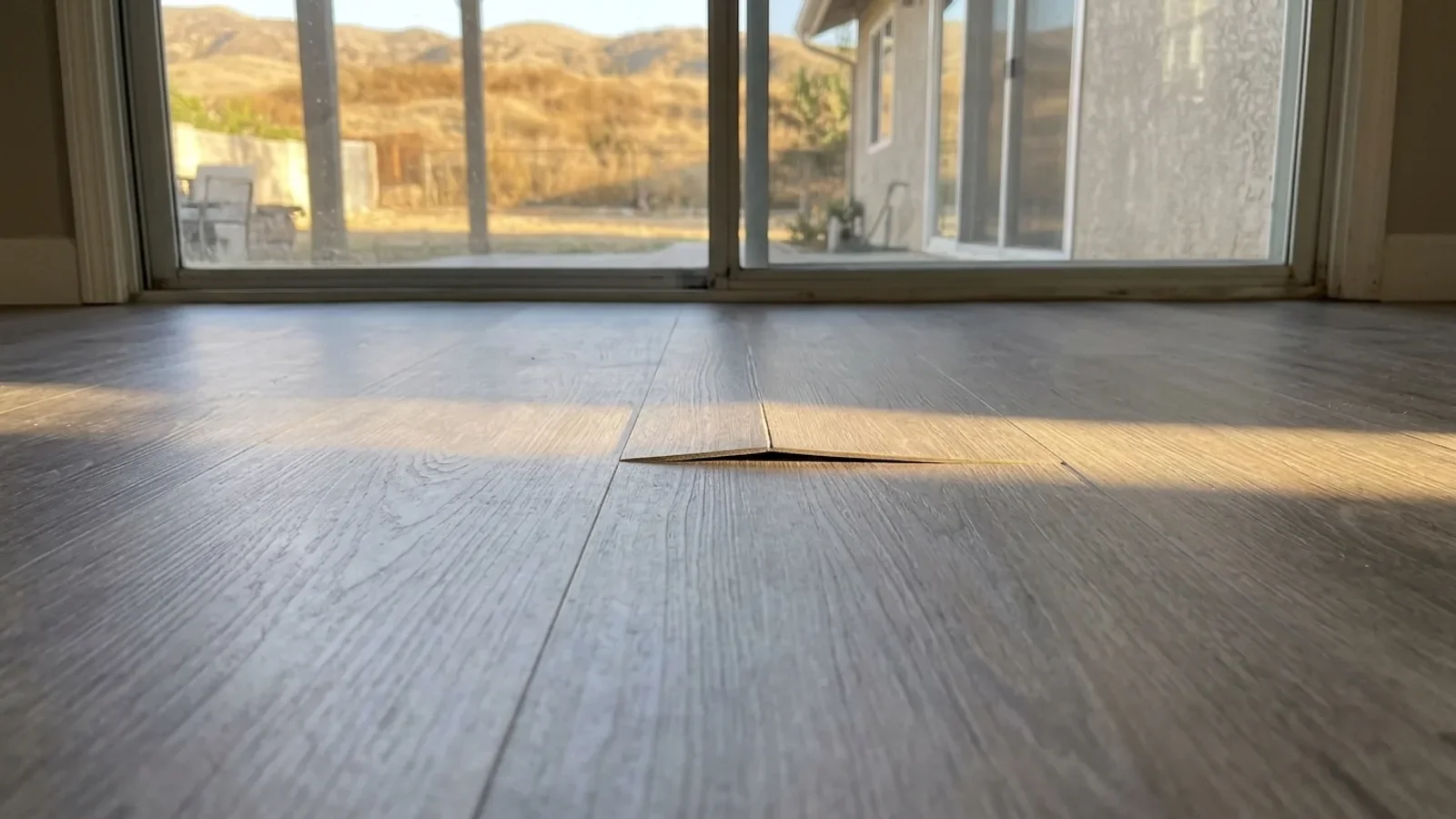
Vinyl is a plastic, and plastics grow when they get hot and shrink when they cool. That’s basic physics, and in the San Fernando Valley it’s a daily event. Summer afternoons here regularly run much hotter than the coast. So vinyl plank acclimation in the San Fernando Valley isn’t a box to tick. It decides whether your floor stays flat.
Does heat really make vinyl planks move?
Yes. Every vinyl plank expands as its temperature climbs and contracts as it drops. On a single plank the change is small. Across a long run of floor, say a hallway that flows into a living room and kitchen, those small changes add up across dozens of joints. If the floor has room to move, you’ll never notice. If it’s pinned against walls, cabinets, or a heavy island, the stress has nowhere to go. The planks push back against each other, and the weakest joint lifts. That’s the peaking or tenting people see in summer. In cooler months the opposite can happen, with hairline gaps opening at the ends of boards. Heat doesn’t ruin vinyl by itself. Restricted movement does.
Why does cheaper vinyl seem to warp more?
Construction matters more than the label on the box. Thin, flexible planks with a light core tend to react more to heat than rigid-core products, because there’s less mass and stiffness holding their shape. Lower-cost click systems can also have shallower locking profiles, and those joints are the first place movement shows up as a lifted edge or a gap. Wear layer thickness affects scratch resistance rather than heat behavior, so don’t judge stability by that number alone. What you want to ask about is the core: is it a dense rigid core, how thick is the plank overall, and what does the manufacturer say about temperature range and sun exposure? A well-built product installed carelessly can still fail. A thin product installed carefully still has limits.
What does vinyl plank acclimation actually mean?
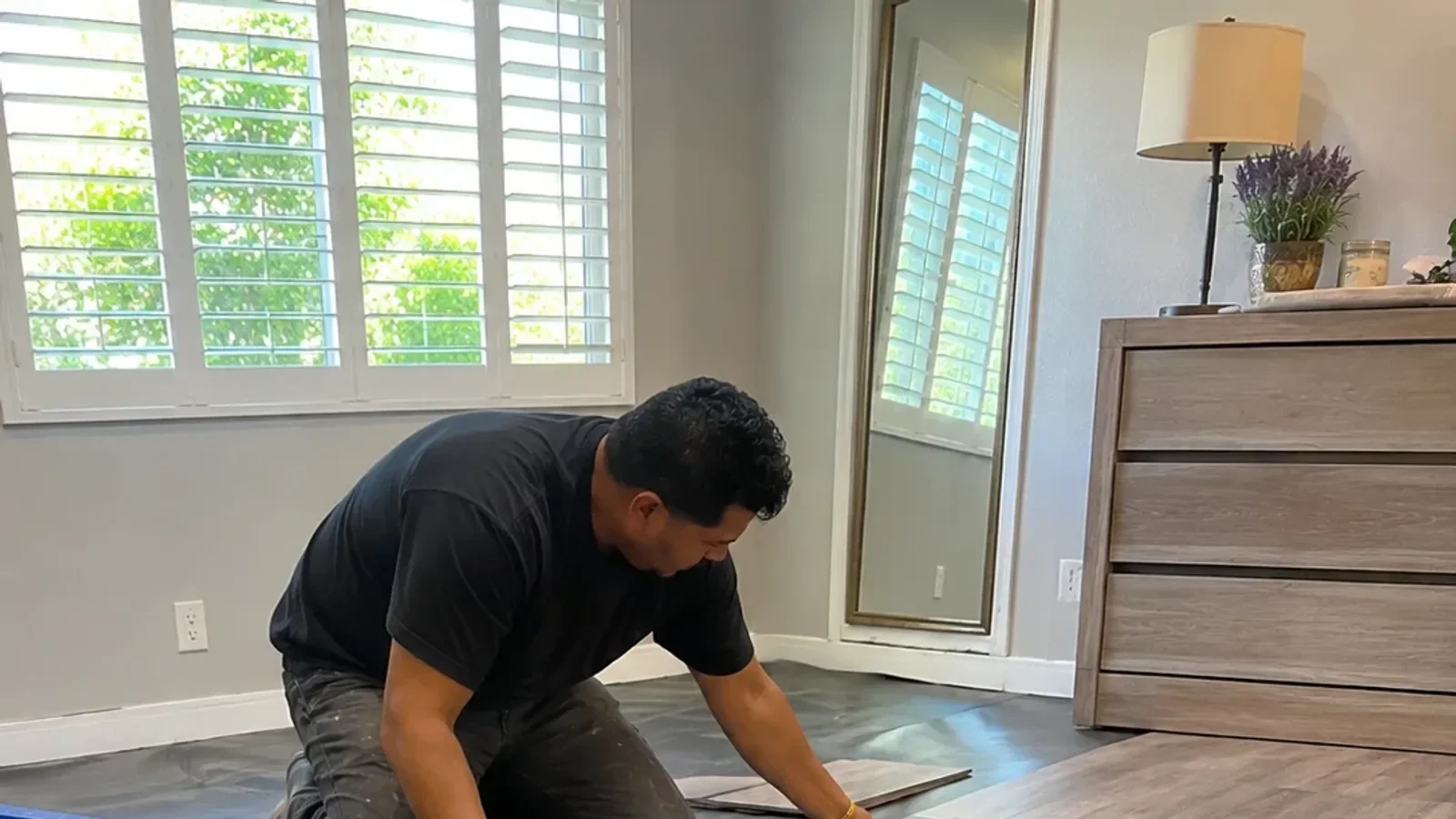
Acclimation means letting the flooring reach the temperature and humidity of the room where it will live before it’s installed. Planks that sat in a hot truck or a cool warehouse are not the same size they’ll be in your living room. Laying them immediately locks in the wrong dimensions. Typically the cartons are brought into the home, stacked flat away from direct sun and vents, and left for the period the manufacturer specifies. Some products call for a set number of hours, some for a couple of days, and some rigid-core lines say minimal acclimation is needed. The rule is simple. Follow the manufacturer’s written instructions for that specific product, because they tie directly to the warranty.
How is acclimation different in the San Fernando Valley than near the coast?
This is where local conditions change the playbook. The Valley sits inland, ringed by the Santa Monica Mountains, the San Gabriels and the Santa Susanas, so it misses most of the marine layer that keeps Santa Monica mild. Summer highs in places like Woodland Hills, Canoga Park and Chatsworth often run well past what the beach sees, and nights cool off noticeably. Santa Ana winds bring hot, very dry stretches in fall. The housing stock adds its own twist. Much of the Valley was built out in the postwar decades, so you’ll find lots of ranch homes on concrete slabs, big sliding glass doors facing the yard, and older single-pane windows that let afternoon sun bake the floor. A plank near a west-facing slider can run far hotter than one in an interior hall. That’s why we pay attention to where the sun lands, not just the thermostat.
Should the air conditioning be running during acclimation and install?
In most cases, yes. The goal is to acclimate and install at the conditions the home will normally be kept at once you’re living on the floor. If your house usually runs with the AC on through summer, that’s the environment the planks should settle into. Acclimating flooring in a closed-up, sweltering house and then cranking the AC to a cool setting afterward creates exactly the swing you’re trying to avoid. The same logic applies in winter, when heat is running. Many manufacturers list a recommended indoor temperature range before, during and after installation. Keep the home inside that range. Keep it steady. Small, consistent daily changes are what a properly installed floor is designed to handle.
Can sunlight through windows warp vinyl even with acclimation?
It can. Acclimation handles the starting size of the plank, but it can’t stop a patch of floor from heating up under strong, direct afternoon sun day after day. Concentrated sun through large glass doors is a common cause of localized expansion, and over time it can also fade some finishes. A few practical habits help. Close blinds or drapes during the hottest hours, especially on west and south exposures. Consider window film or shades on big sliders. Avoid placing dark rugs with rubber backing in sunny spots, since they can trap heat. Some manufacturers specifically address direct sun exposure in their warranty terms, so ask about that before you choose a product for a sun-drenched room.
What else causes heat-related buckling besides skipping acclimation?
Several installation details matter just as much. Expansion gaps at walls, door casings and fixed objects give the floor room to grow, and baseboards or quarter round hide them. Transitions between rooms break up very long runs so movement doesn’t accumulate across the whole house. Floating floors shouldn’t be locked down by heavy built-ins installed on top of them. The subfloor matters too, because dips and high spots strain the locking joints. On Valley slab homes, flatness and moisture checks come first, which we cover in our guide to getting a Canoga Park concrete slab ready for vinyl. For the full sequence of prep, layout and transitions, see how we handle vinyl floor installation in San Fernando Valley homes.
How can I tell if my floor problem is heat or something else?
Timing is the clue. Heat-related movement tends to show up on hot afternoons or after a heat wave, often near sunny windows or along long, uninterrupted runs, and may ease a bit when things cool down. Gaps that open in the cooler months point the same direction. Problems that stay put regardless of weather usually trace back to the subfloor, a failed locking joint, or moisture. Soft spots, hollow sounds and boards that rock suggest an uneven base. A musty smell or discoloration near the edges points toward moisture rather than temperature. Don’t try to force lifted planks back down or cut the floor yourself. Have the floor looked at so the cause gets fixed, not just the symptom.
Will waterproof vinyl still need care once it’s in?
Waterproof refers to the planks resisting water, not to the floor being immune to everything. Grit still scratches, heavy furniture can dent, and sun still heats the surface. Felt pads under chair and table legs, a gentle cleaner the manufacturer approves, and drawing the blinds on hot afternoons all help the floor look good longer. Wipe spills promptly too, because water left sitting at the edges can find its way under a floating floor. Our care tips for waterproof vinyl in Valley homes go into more detail on cleaning and seasonal habits. If you’re shopping now, it also helps to match the product to the room’s sun and traffic before you buy.
The short version
Valley heat doesn’t automatically ruin vinyl. Floors fail when a less stable product meets a hot, sunny room and an install that didn’t respect acclimation, expansion gaps or a flat subfloor. Choose a rigid, well-built plank. Acclimate it to the conditions you’ll actually live in. Leave it room to move. If you’d like to see and compare vinyl options in person, stop by the IDN Hardwood and Carpet Superstore showroom in Canoga Park, or read about our approach to waterproof vinyl installation across the Valley. When you’re ready, our team can walk you through planning a vinyl plank install for your home.